
The National Standard Examinations, or NSEs, are where India's science olympiad programme begins for students in Classes 10 to 12. They lead, stage by stage, towards the International Olympiads in physics, chemistry, biology and astronomy. A separate junior route, NSEJS, serves younger students in Classes 8 to 10.
This guide explains who runs what, who can write, how the calendar runs (last cycle and the likely 2027-28 window), and how to prepare. For the full landscape of olympiads, see our guide to olympiad exams in India.
A timing note. The 2026 NSEs were held on 21 and 22 November 2026, so this cycle's first stage has already passed. Preparation from here is for NSE 2027, expected in late November 2027, with a full year to build up.
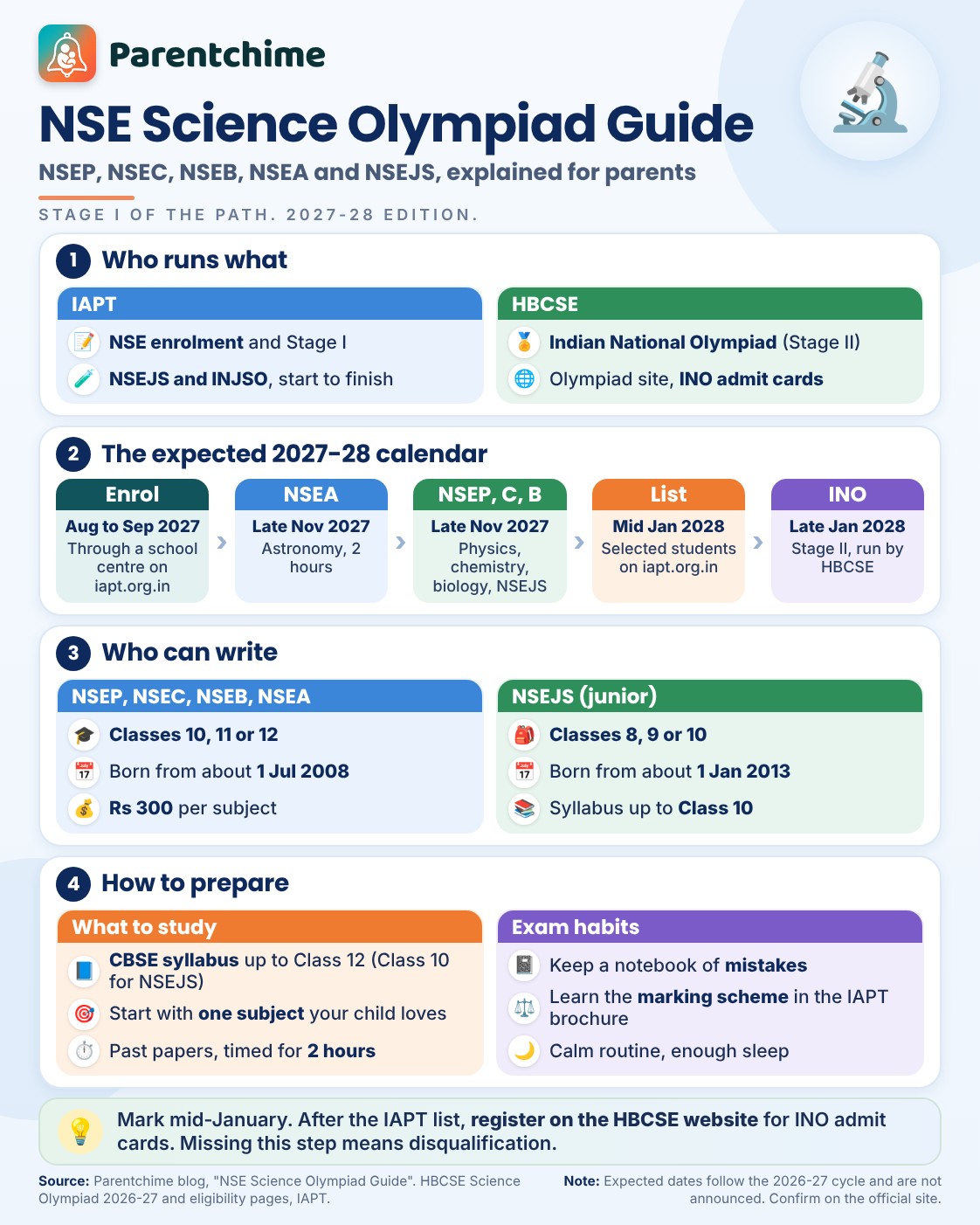
Who runs what
Two organisations share the work, and parents often mix them up:
- IAPT (Indian Association of Physics Teachers) handles NSE information and enrolment, and runs the Junior Science exams (NSEJS and INJSO) from start to finish.
- HBCSE (Homi Bhabha Centre for Science Education, TIFR Mumbai) runs the Indian National Olympiad exams at Stage II and maintains the science olympiad website.
The HBCSE page describes a five-stage selection process that leads to participation in the International Olympiads. Stage I is NSE, Stage II is the Indian National Olympiad (INO), and Stage III is an orientation-cum-selection camp. The later stages choose the students who travel. Our guide to INO, OCSC and the international route covers those later stages, and our guide to NSEJS and INJSO covers the junior route.
The calendar: last cycle and likely 2027-28
| Step | 2026-27 | Likely in 2027-28 (not announced) |
|---|---|---|
| NSE centre registration | 1 to 20 August 2026 | August 2027 |
| Student enrolment | 21 August to 14 September 2026 (IAPT showed an extension to 16 September) | August to mid-September 2027 |
| NSEA (astronomy) | 21 November 2026 | Around the third or fourth weekend of November 2027 |
| NSEP, NSEC, NSEB and NSEJS | 22 November 2026 | The day after NSEA, around late November 2027 |
| Selected students listed on iapt.org.in | By 15 January 2027 | Around mid-January 2028 |
| INAO and INChO / INPhO and INBO | 30 and 31 January 2027 | Around late January 2028 |
The fee listed by HBCSE for 2026 was Rs 300 per student per subject. It may change.
If your child is already in the 2026-27 cycle: students selected from NSE should check iapt.org.in for the list by 15 January 2027 and then register on the HBCSE website for INO on 30 and 31 January. Everyone else can use the months ahead as a head start for 2027.
Who can write
For NSEP, NSEC, NSEB and NSEA in 2026, IAPT and HBCSE list these conditions:
- Studying in Class 10, 11 or 12 on 30 November 2026
- Born between 1 July 2007 and 30 June 2012, both dates included
- Eligible to hold an Indian passport (OCI students are provisionally eligible up to Stage III but cannot join the international team)
- Living and studying in India, or in the Indian school system, since 30 November 2024 or earlier
- Not appearing in NSEJS 2026, not completing the Class 12 board exams before 30 November 2026, and not starting university by 1 June 2027
For NSEJS, IAPT lists Classes 8, 9 and 10 on 30 November 2026, with students born between 1 January 2012 and 31 December 2013.
The birth-date windows move forward about a year at a time, so expect the 2027 window to start around 1 July 2008 for NSEP, NSEC, NSEB and NSEA, and around 1 January 2013 for NSEJS. Please confirm in the new notice.
HBCSE adds that students are responsible for checking their own eligibility and can be disqualified later if they do not meet it.
What the papers look like
IAPT states that the NSEP, NSEC, NSEB and NSEA syllabus covers content up to Class 12 under CBSE, and NSEJS covers physics, chemistry and biology up to Class 10. The exams run for two hours.
Preparation sites that summarise the IAPT student brochure describe an objective paper of 60 questions worth 216 marks, with a first section of single-correct questions that carries negative marking and a second section of multiple-correct questions that does not. Please confirm the exact pattern in the current IAPT student brochure before your child sits the exam, as these details come from secondary summaries and could change.
How to prepare
Build on school first. Because the syllabus is anchored to Class 12 content, a child who understands NCERT physics, chemistry or biology deeply is already most of the way there. The olympiad twist is depth and application.
Pick one subject to begin with. One subject done well beats three done in a hurry. Let your child choose the one they genuinely enjoy.
Practise with past papers. IAPT and HBCSE publish past papers and sample questions. Time a full two-hour paper at home a few times before the exam.
Learn the marking scheme. If the single-correct section carries negative marking, teach your child to skip a question they cannot narrow down. If the multiple-correct section has none, they should attempt every question there.
Revisit mistakes. Keep a notebook of questions that went wrong and why. This is the most efficient revision tool there is.
Start early for the junior route. NSEJS is a gentle way to try an olympiad-style paper in Class 8 or 9, and it leads to INJSO.
A year plan for the 2027-28 cycle
- Now to May 2027 (for NSE 2027): build the NCERT base in the subject your child likes best. Keep a mistakes notebook.
- June and July 2027: ask the school whether it is an NSE centre and who coordinates it.
- August to mid-September 2027: watch iapt.org.in for centre registration and student enrolment. Enrol early.
- September to early November 2027: past papers, timed at two hours, once a week.
- Late November 2027: NSE, expected around the same weekend as this year.
- First half of January 2028: check the IAPT list and register on the HBCSE website for INO if selected.
The one deadline parents miss
After the list of selected students is published on the IAPT website, the student must register on the HBCSE website to receive an INO admit card. HBCSE states that failure to register results in disqualification from INO. Set a reminder for the first half of January.
What parents can do
- Ask your child's school whether it is a registered NSE centre well before August.
- Keep the focus on learning. Ranks at this level are very competitive, and a calm approach protects your child's confidence.
- Confirm all dates on the official sites, because they shift each year.
Where to check current details
- IAPT
- HBCSE Science Olympiad page
- HBCSE eligibility page
- HBCSE Science Olympiads contact: scioly@hbcse.tifr.res.in
Comments
No comments yet. Be the first to share what worked for your family.