
Not every national competition needs a coaching class or an entrance fee. The CBSE Science Challenge is a school-led science competition for Classes 8 to 10 in CBSE-affiliated schools. The Central Board of Secondary Education announced the 2026-27 edition in a circular dated 13 October 2026.
How it works
The challenge runs in two rounds:
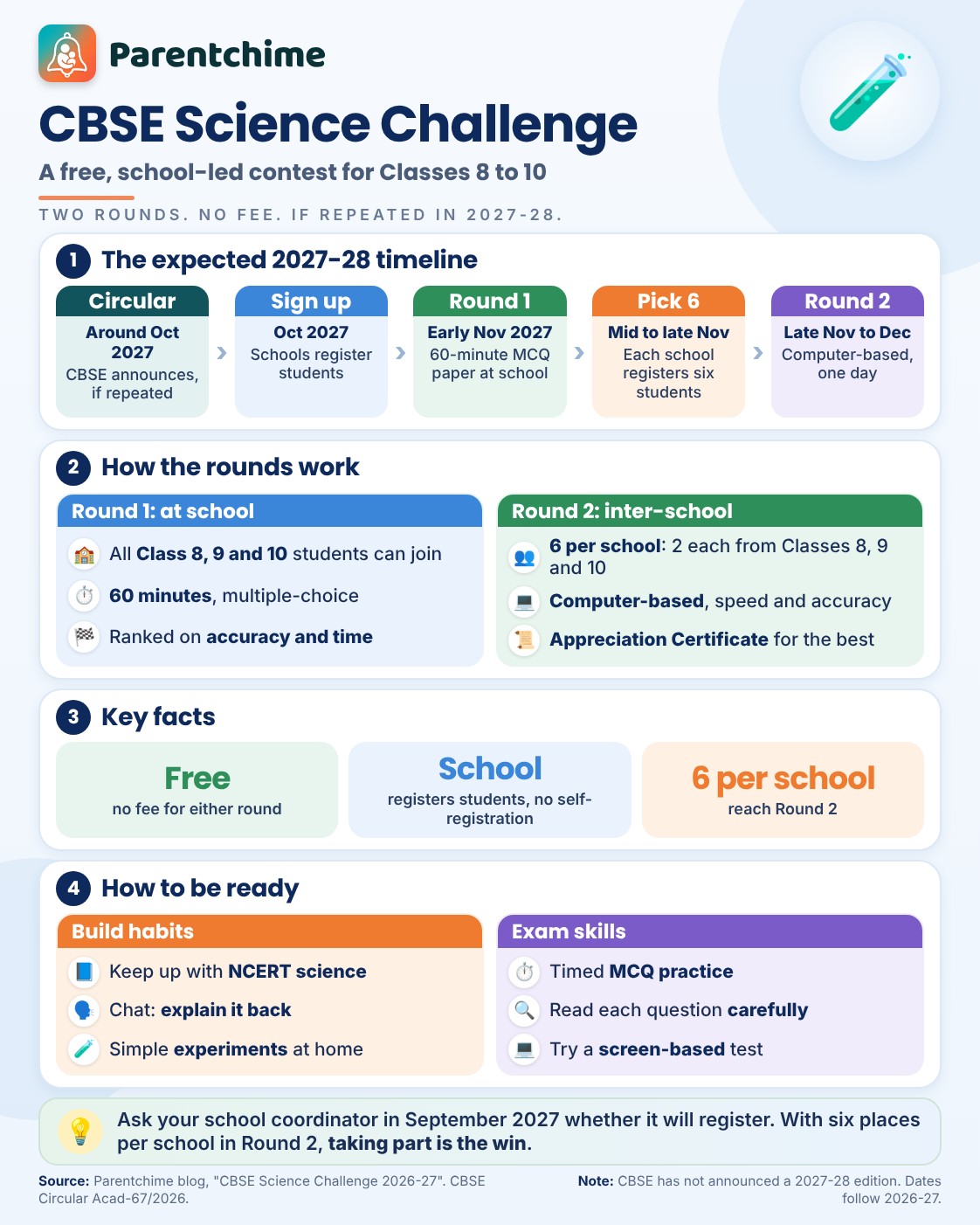
Round 1 (school level). The school registers its students on the CBSE Science Challenge portal, and all eligible students in Classes 8, 9 and 10 can take part. The paper, made up of multiple-choice questions with scoring criteria, was released on the portal on 2 November, and schools conducted it between 2 and 13 November 2026. The time limit is 60 minutes, and students are ranked on both accuracy and the time they take.
Round 2 (computer-based). Based on how students did in Round 1, the school picks 6 students, 2 each from Classes 8, 9 and 10, and registers them for Round 2. Registration for Round 2 ran from 17 to 25 November 2026. The Board conducts the computer-based test on a single day, tentatively between 30 November and 4 December 2026, with the exact date notified later. Only schools that completed Round 1 and registered students can take part.
Because the first round is organised by the school, your child's teacher decides how it is run on the ground. Ask the science teacher how students were chosen.
Why it is worth knowing about
- It is open to every eligible student in a participating school, so your child does not need to qualify through an entrance test first.
- It runs through the school, so there is no separate application for families to handle.
- It rewards curiosity and scientific thinking, which is a good fit for children who ask "why".
- It is free for students. The CBSE circular states there is no fee for either round.
- All Round 2 participants receive an online participation certificate from the Board, and the best performers receive an Appreciation Certificate.
How to prepare
The questions are released on the portal only on the day, so there is nothing specific to memorise. Because students are ranked on accuracy and speed, these habits help:
- Keep up with the school science syllabus. A confident grasp of NCERT Classes 8 to 10 science covers a lot of ground.
- Encourage "explain it back" conversations. If your child can explain why ice floats or how a circuit works, they are thinking like a scientist.
- Try simple experiments at home. Kitchen science, a basic circuit with a bulb and battery, or growing seeds under different conditions all build observation skills.
- Practise reading questions carefully. Many mistakes come from rushing through the wording.
- Practise multiple-choice questions against a clock. With 60 minutes in Round 1 and speed counted in the ranking, a little timed practice helps.
- Get comfortable on a screen. Round 2 is computer-based, so a bit of practice with on-screen tests is useful.
What to expect in 2027-28
CBSE has not said whether the Science Challenge will return, so treat the following as a planning guide rather than a promise:
- Likely timing if repeated: a circular around October 2027, school registration shortly after, Round 1 at school in early November 2027, and Round 2 in late November or early December 2027.
- Round 2 this season: for schools that took part in 2026-27, Round 2 is tentatively on a single day between 30 November and 4 December 2026. Check cbseacademic.nic.in for the exact date.
- Who it suits: current Class 7, 8 and 9 students, who will be in Classes 8, 9 and 10 next year.
A calm plan for the months ahead: keep up with NCERT science, try one home experiment a month, and practise a few timed multiple-choice sets in September and October 2027.
What parents can do
- Ask the school whether it registered for the 2026-27 challenge and when the next call is likely.
- Keep expectations light. With only 6 students going from each school to Round 2, being picked at all is a good result.
- Check the CBSE circular and the portal for current dates.
Where to check current details
- CBSE circular Acad-67/2026
- Your child's school coordinator for local timings
Comments
No comments yet. Be the first to share what worked for your family.