
If your child is in Class 8, 9 or 10 and loves science, the junior science olympiad route is the way in. It is a gentler start than the senior route, and it leads to two international olympiads: the International Junior Science Olympiad (IJSO) and the International Olympiad on Astronomy and Astrophysics for Juniors (IOAA-Junior).
This guide explains NSEJS, INJSO, the selection camp and the two international routes, using the IAPT student brochure and NCSM's page. For the senior route in Classes 10 to 12, see our guide to NSE and our guide to INO, OCSC and the international route. For the full landscape, see our guide to olympiad exams in India.
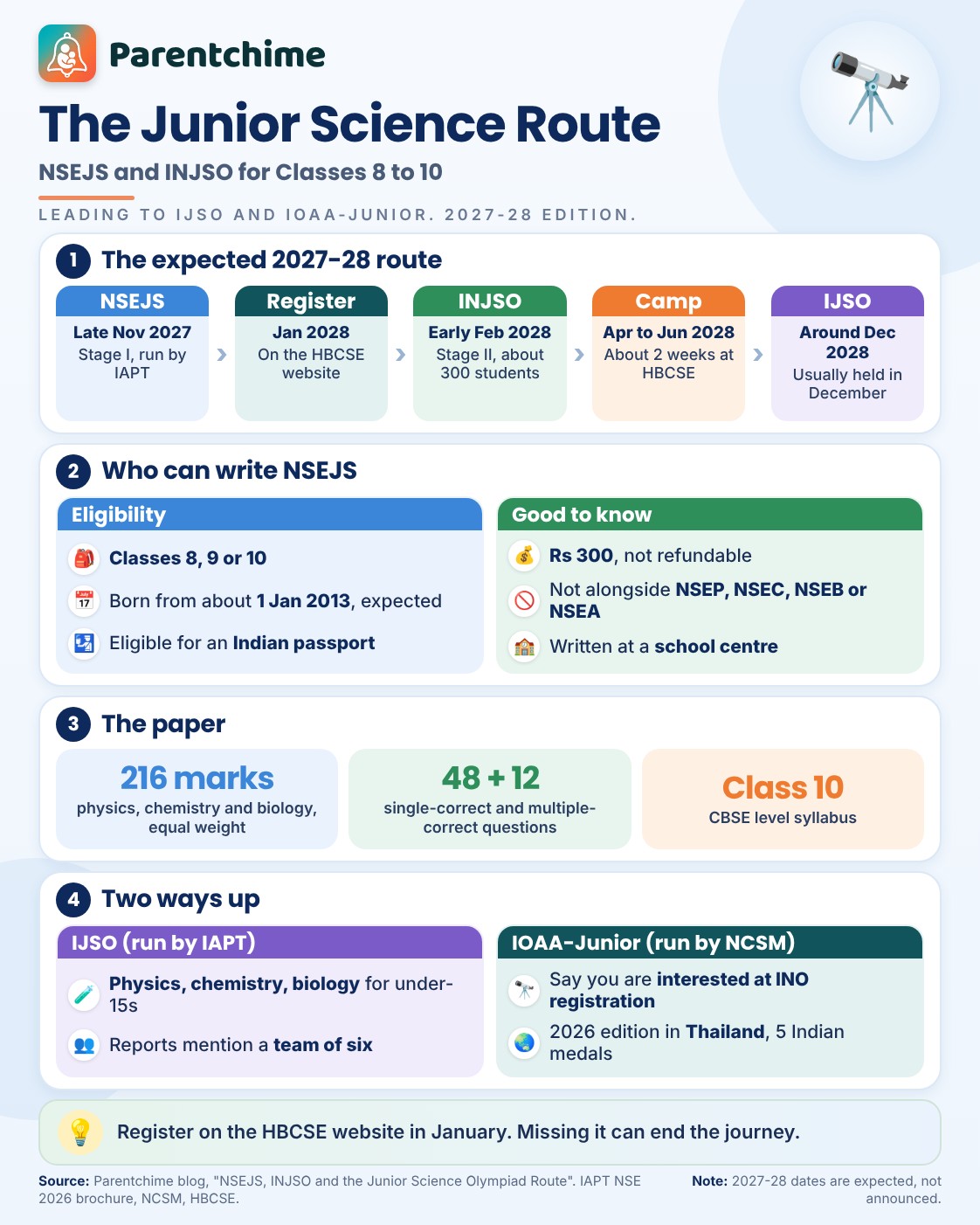
A timing note. NSEJS 2026 was held on 22 November 2026, so the first stage for this cycle has already passed, and INJSO cannot be entered directly. If your child wrote NSEJS, watch for the results around 25 December. If not, the best use of the coming year is preparing for NSEJS in late November 2027.
Who runs what
- IAPT (Indian Association of Physics Teachers) runs NSEJS and INJSO. HBCSE's own page says these two exams are conducted entirely by IAPT and not by HBCSE.
- HBCSE hosts the website where shortlisted students register, and the IAPT brochure places the junior selection camp at HBCSE in Mumbai.
- NCSM (National Council of Science Museums) runs the Junior Astronomy Olympiad programme and selects the IOAA-Junior team.
The stages
| Stage | What it is | Roughly how many go through |
|---|---|---|
| I | NSEJS | Many students write it |
| II | INJSO | A target of about 300 students |
| III | Orientation-cum-Selection Camp (junior science) | Reports mention about 35 |
| IV | Pre-departure training | The selected team |
| V | International Junior Science Olympiad | News reports describe a team of six |
The calendar: last cycle and the likely 2027-28 window
| Step | 2026-27 | Likely in 2027-28 (not announced) |
|---|---|---|
| Student enrolment | 21 August to 14 September 2026 | August to mid-September 2027 |
| NSEJS | 22 November 2026 | Late November 2027 |
| First-stage results | Expected 25 December 2026 | Around late December 2027 |
| Registration on the HBCSE website | January 2027 | January 2028 |
| INJSO | First week of February 2027 | First week of February 2028 |
| INJSO results | Last week of February 2027 | Last week of February 2028 |
| Selection camp | April to June 2027, about two weeks | April to June 2028 |
| IJSO | Usually held in December | Around December 2028 |
If your child is already in the 2026-27 cycle: if they wrote NSEJS on 22 November, watch iapt.org.in for the results around 25 December, and register on the HBCSE website in January if shortlisted.
Who can write NSEJS
IAPT lists these conditions for 2026:
- Eligible to hold an Indian passport.
- Born between 1 January 2012 and 31 December 2013, both dates included.
- Residing and studying in India, or in the Indian school system, since 30 November 2024 or earlier.
- Not completing the Class 10 board exam before 30 November 2026.
- Not appearing in NSEA, NSEB, NSEC or NSEP in 2026. A student writes either the junior NSE or the senior ones, not both.
That birth-date window covers Classes 8, 9 and 10. It moves forward about a year at a time, so expect the 2027 window to start around 1 January 2013 and confirm in the new brochure.
What the paper looks like
IAPT describes NSEJS as broadly equal to the secondary level up to and including Class 10 of CBSE, with physics, chemistry and biology given equal emphasis. The brochure's pattern is 216 marks:
- Section A: 48 single-correct questions, +3 for a right answer and -1 for a wrong one.
- Section B: 12 questions of 6 marks each, where one or more options can be correct, and full credit needs every correct option and no incorrect ones.
The brochure shows this pattern once for all the NSEs, so confirm the NSEJS section in the current notice. The paper is in English or Hindi, chosen at enrolment. IAPT's schedule shows a two-hour afternoon window on exam day, but the table does not clearly tie the time to NSEJS, so check your child's admit card.
The fee is Rs 300 per student per subject and cannot be refunded. Students can sit the exam only at a registered centre, so ask your child's school early whether it is one.
From NSEJS to INJSO
IAPT's brochure sets a target of about 300 students for INJSO. It uses the same method as the senior exams: a minimum admissible score of half the average of the top ten scores, automatic entry at 80 percent of that average, state quotas (at least five per state) and at least 20 percent girls.
Shortlisted students must register on the HBCSE website in January. As in the senior route, missing that registration can end the journey, so set a reminder. The brochure does not describe the INJSO paper format, so watch for the notice after your child is shortlisted.
The junior selection camp
The best INJSO performers attend an orientation-cum-selection camp at HBCSE in Mumbai, which IAPT says lasts about two weeks and runs between April and June. The IAPT brochure does not give the number of students or the team size. Education news reports mention a camp of about 35 students and a team of six, so treat those as reported figures, not official ones. IAPT adds that every student who attends the camp receives a gold medal.
Two ways up: IJSO and IOAA-Junior
IJSO. The International Junior Science Olympiad is for students under 15 in physics, chemistry and biology. It has usually been held in December, for example in Bogota in December 2022. IAPT's brochure does not name the 2027 host or the team size.
IOAA-Junior. NCSM runs this route. Students come through NSEJS and INJSO, and NCSM says selection for its later stages is based on INJSO performance among students who express interest during INO registration. That makes registration the key moment for a child who loves astronomy. The 2026 selection camp was held at the Birla Industrial and Technological Museum in Kolkata, and the 5th IOAA-Junior took place in Ubon Ratchathani, Thailand from 1 to 8 November 2026, where Indian students won two gold, two silver and one bronze medal, according to NCSM and news reports. NCSM's page has no information about 2027, so write to NCSM if your child is interested.
Awards on the way
IAPT lists certificates for the top 10 percent of students at every centre, merit certificates for the top 1 percent in each state, and special merit certificates with a book prize for the national top 1 percent in junior science, physics and astronomy.
How to prepare
Start with school science. NSEJS covers physics, chemistry and biology up to Class 10, so a child who understands the NCERT textbooks well has the base. The olympiad twist is applying ideas to unfamiliar problems.
Practise the pattern. The two-part structure matters. In Section A a wrong answer loses a mark, and in Section B all-or-nothing marking rewards careful reasoning. Teach your child to skip a question they cannot narrow down in Section A, and to check each option on its own in Section B.
Time full papers. A few timed papers at home, in the two-hour window, build stamina and calm.
Keep a mistakes notebook. Write down every wrong answer and why. This is the most efficient revision tool there is.
Start early. Class 8 or 9 is a good time to try NSEJS for the experience, because the senior route stays open later.
Protect the joy. Ranks at this level are competitive. A calm approach protects your child's confidence and school year.
A year plan for the 2027-28 cycle
- Now to May 2027 (for NSEJS 2027): build NCERT depth in physics, chemistry and biology, with an extra hour of curious reading or experiments each week.
- June to July 2027: ask the school whether it is a registered NSE centre.
- August to mid-September 2027: watch iapt.org.in for the new brochure and enrol early.
- October to November 2027: weekly timed papers, then NSEJS in late November.
- Late December 2027: check the results.
- January 2028: if shortlisted, register on the HBCSE website at once, and say so if your child wants the astronomy route.
- February 2028: INJSO.
- April to June 2028: the camp, if selected.
What is not published
To keep this guide honest, IAPT's brochure does not state the INJSO paper format, the number of students at the junior camp, the IJSO team size or the 2027 IJSO host. Please check iapt.org.in as the dates near.
Comments
No comments yet. Be the first to share what worked for your family.