
If you are weighing a Sainik School for your child, the useful question is when to start. The All India Sainik Schools Entrance Examination, or AISSEE, is run by the National Testing Agency for the Sainik Schools Society. Applications for each edition are typically open between October and December, and the exam follows around January. Keep an eye on the NTA portal from September.
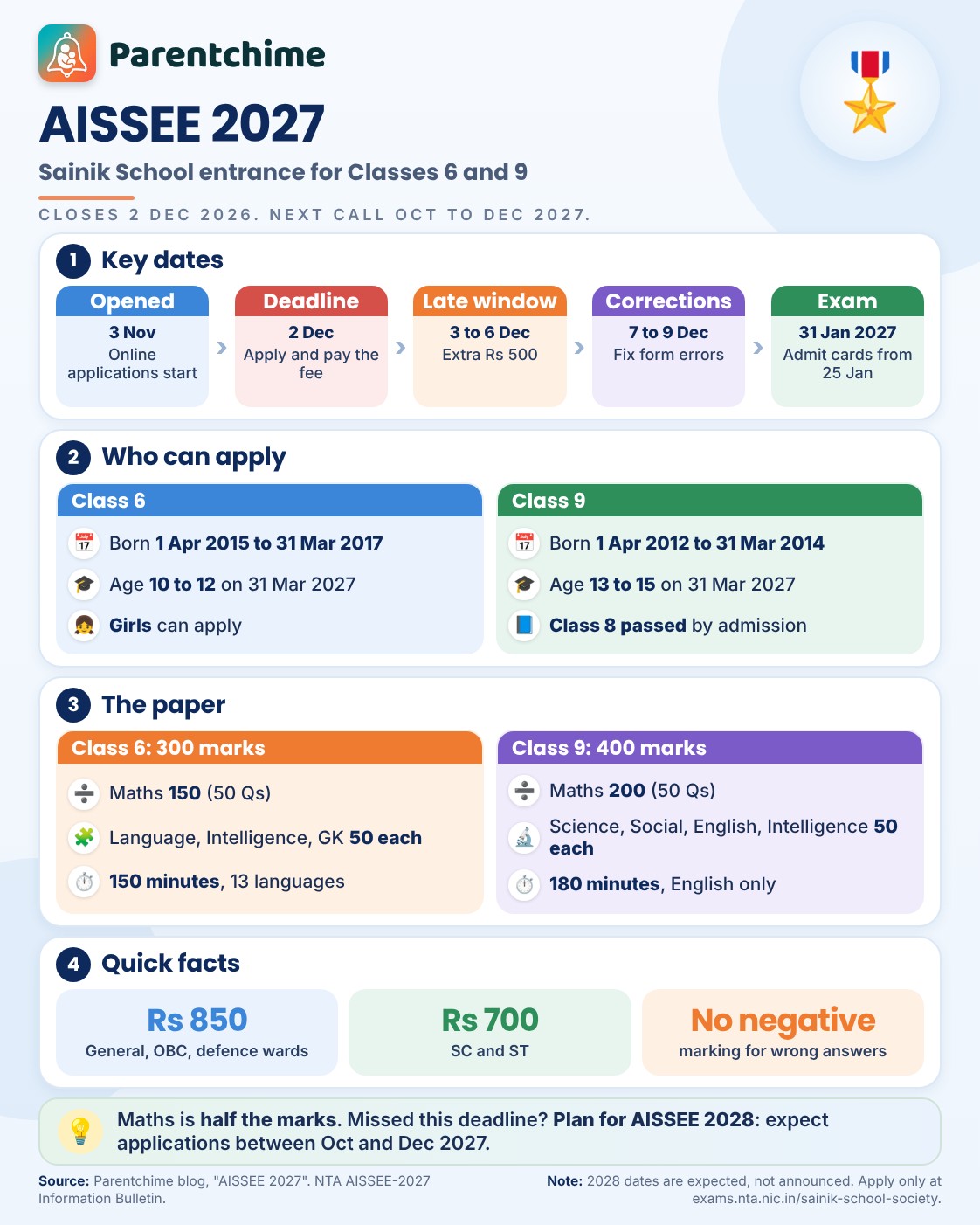
AISSEE is an admission test, which makes it different from the Olympiads and scholarship exams in the rest of this series. We cover it here because many families are also weighing Olympiad pathways, and because the preparation overlaps.
When does AISSEE 2028 open?
The 2028 dates are not announced yet, and you do not need exact dates to plan. What the last two editions show:
| AISSEE 2026 edition | AISSEE 2027 edition | AISSEE 2028 (expected) | |
|---|---|---|---|
| Applications | 10 October to 9 November 2025 | 3 November to 2 December 2026 | Typically between October and December 2027 |
| Late window | Not covered here | 3 to 6 December 2026, extra Rs 500 | Likely a few days after the close |
| Exam | Before the February 2026 result | 31 January 2027 | Around January 2028 |
| Result | 27 February 2026 | Not yet announced | Around February or March 2028 |
The window moved by about three weeks between these two editions, so the safest habit is to check the official portal at the start of September and every couple of weeks after that. Apply early, since the late window carries an extra fee.
If your child is in Class 5 or Class 8 right now: applications for AISSEE 2027 close on 2 December 2026, with a late window from 3 to 6 December. The exam is on 31 January 2027.
Who can apply
The 2027 bulletin is the best guide to 2028, and we do not expect the rules to change. The birth-date windows move forward about a year at a time, so confirm them when the 2028 bulletin comes out.
Class 6. Age 10 to 12 on 31 March of the exam year. In the 2027 bulletin this meant born between 1 April 2015 and 31 March 2017. For 2028, expect roughly 1 April 2016 to 31 March 2018.
Class 9. Age 13 to 15 on 31 March of the exam year. In the 2027 bulletin this meant born between 1 April 2012 and 31 March 2014. For 2028, expect roughly 1 April 2013 to 31 March 2015. The child must have passed Class 8 from a recognised school by the time of admission.
Girls can apply for both classes, subject to seat availability. The 2027 bulletin reserves 10 percent of Class 6 strength or 10 seats, whichever is higher, for girls in the Sainik Schools.
The fee
In the 2027 cycle:
- General, OBC (non-creamy layer), wards of defence personnel and ex-servicemen: Rs 850
- SC and ST: Rs 700
- Late submission: an extra Rs 500
Payment charges and taxes were extra, and the fee was not refundable. Check the 2028 bulletin for any change.
The paper
The paper followed the pattern below in the 2027 bulletin, and we do not expect it to change. It is multiple-choice, answered with pen on an OMR sheet, with no negative marking.
Class 6: 125 questions, 300 marks, 150 minutes
| Section | Questions | Marks each | Total |
|---|---|---|---|
| Language | 25 | 2 | 50 |
| Mathematics | 50 | 3 | 150 |
| Intelligence | 25 | 2 | 50 |
| General Knowledge | 25 | 2 | 50 |
Class 9: 150 questions, 400 marks, 180 minutes
| Section | Questions | Marks each | Total |
|---|---|---|---|
| Mathematics | 50 | 4 | 200 |
| Intelligence | 25 | 2 | 50 |
| English | 25 | 2 | 50 |
| General Science | 25 | 2 | 50 |
| Social Science | 25 | 2 | 50 |
Maths carries half the marks in both papers. That one fact should shape how your child spends their preparation time.
The Class 6 paper can be taken in 13 languages (English, Hindi, Marathi, Odia, Bengali, Assamese, Punjabi, Tamil, Gujarati, Telugu, Kannada, Urdu and Malayalam). The Class 9 paper is in English only.
How selection works
To be considered, a candidate needs at least 25 percent in each section and 40 percent in aggregate. SC and ST candidates are exempt from this for the existing Sainik Schools. Admission then follows through e-counselling, based on merit rank, medical fitness and document verification.
Seats in the Sainik Schools are reserved: 67 percent for home-state candidates and 33 percent for other states and Union Territories, with further reservations for SC, ST, OBC (non-creamy layer) and defence wards. Merit lists are prepared school by school and category by category, and separately for boys and girls. Seat numbers change each year, so check the vacancy appendices in the bulletin for the school you have in mind.
A year plan for AISSEE 2028
With the exam expected around January 2028, there is plenty of time to build a steady routine.
- Now to May 2027: a daily maths habit of 20 minutes, plus a puzzle book for the Intelligence section.
- June to September 2027: one timed paper a month, a short daily reading habit, and a talk with your child about what a residential school day looks like.
- September 2027: start checking exams.nta.nic.in/sainik-school-society every couple of weeks.
- October to December 2027: keep the birth certificate, school details, photograph and signature ready, then apply early.
- December 2027 to January 2028: a full timed paper every week in the last month before the exam.
How to spend the study time:
- Put maths first. Half the marks come from it. For Class 6, revise Class 5 maths and practise speed on number work, fractions, simple geometry and word problems. For Class 9, revise the Class 8 syllabus thoroughly.
- Add reasoning daily. Patterns, series, analogies and odd-one-out puzzles appear in the Intelligence section.
- Read a little every day. For Class 6, the Language and General Knowledge sections reward children who read newspapers for children, story books and a short daily bit of current affairs.
- Practise full papers against the clock. Class 6 is 150 minutes and Class 9 is 180.
- Learn to use an OMR sheet. Practise shading bubbles neatly with a pen. Careless marking costs marks that knowledge has already earned.
- Keep sleep and play. The paper is long, and a rested child with a calm routine does better than one who crams.
A realistic way to think about it
Competition for Sainik School seats is strong, and seats are limited. A good approach is to treat the preparation as useful in itself. A child who builds strong maths and reasoning habits gains those skills whether or not a seat comes through. It also helps to talk early about residential school life, so the child is part of the decision.
Comments
No comments yet. Be the first to share what worked for your family.