
The Dr. Homi Bhabha Balvaidnyanik Competition is one of the older and more respected science competitions for school children in India, and it works differently from most Olympiads. It is not just a written paper. Children who do well go through a practical round, a research project and interviews. The 2026-27 written round is on Saturday 28 November 2026, and the 2027-28 cycle should follow a similar calendar.
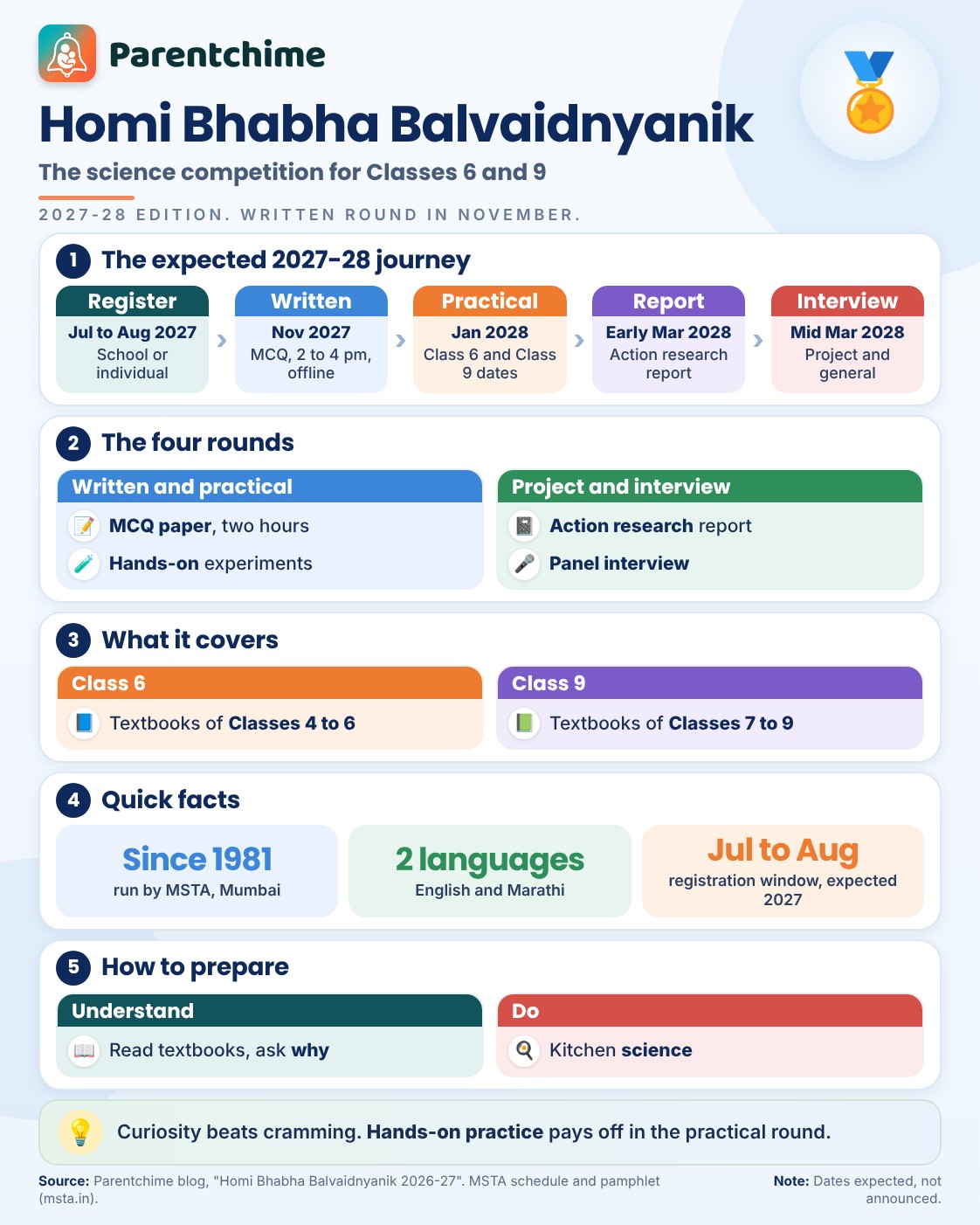
It is run by the Greater Bombay Science Teachers' Association (also known as the Mumbai Science Teachers' Association, MSTA), which has held it since 1981. It is for children in Class 6 and Class 9, and the exam can be taken in English or Marathi. Registration for this cycle has closed, so this guide is for registered families and for anyone planning for 2027-28.
The schedule: last cycle and likely 2027-28
The 2026-27 dates come from MSTA's own schedule and information pamphlet. The 2027-28 column is an expectation based on them, and MSTA has not announced it.
| Stage | 2026-27 (last cycle) | Likely in 2027-28 |
|---|---|---|
| Registration through school | 1 to 31 July 2026 | July 2027 |
| School registration with late fee (Rs 25 per student) | 1 to 18 August 2026 | Up to mid-August 2027 |
| Individual registration | 1 July to 18 August 2026 | July to mid-August 2027 |
| Written (MCQ) round | 28 November 2026, 2:00 to 4:00 pm | A Saturday in November 2027, 2:00 to 4:00 pm (the 2025-26 written round was on 8 November) |
| MCQ result | 20 December 2026 | December 2027 |
| Practical round, Class 6 | 10 January 2027 | January 2028 |
| Practical round, Class 9 | 24 January 2027 | Late January 2028 |
| Practical result | 15 February 2027 | February 2028 |
| Action research report due | 8 March 2027 | Early March 2028 |
| Interviews | 14 March 2027 | Mid-March 2028 |
MSTA notes that the theory competition is held offline this year as well. Your child's hall ticket and centre details come from the school or from MSTA.
If your child is in this year's cycle: the written round is on 28 November, the MCQ result is due on 20 December 2026, and the practical rounds follow in January.
How the rounds work
1. Written round (MCQ). A two-hour paper held on 28 November. Coverage of the paper's format on the competition's own information site describes 100 questions in 90 minutes with no negative marking, and says only a small share of candidates, roughly the top 7.5 percent, move on. Treat these numbers as indicative and confirm them in the MSTA information circular.
2. Practical round. Qualifiers do short, hands-on science tasks. Class 6 children work on science and environment experiments, and Class 9 children on physics, chemistry and biology experiments. This is a skills test: can the child handle simple apparatus, observe carefully and explain what they see?
3. Action research project. Students work at home on a small research question and submit a report in March.
4. Interviews. A project interview and a general interview with a panel of experts, testing scientific thinking and how clearly the child explains their ideas.
Awards include gold, silver and bronze medals and certificates, and the competition's information pages mention scholarships or cash prizes for top students, with amounts that change from year to year.
What the written paper covers
MSTA's pamphlet describes the syllabus as the science textbooks of the Maharashtra State Board and other boards.
- Class 6: science textbooks of Classes 4, 5 and 6
- Class 9: science textbooks of Classes 7, 8 and 9
In other words, children are tested a little below their own class as well, which rewards steady understanding over last-minute memorising.
Fees
Fees depend on how the child registered, and include a copy of the official handbook. MSTA's website lists school registration at Rs 420 for Marathi medium and Rs 520 for English medium, and individual registration at Rs 700. Some other pages show older, lower figures, so use msta.in as the reference.
The last few days before the written round
- Read a few chapters of the Class 4 to 6 (or 7 to 9) science textbooks and ask "why" questions out loud.
- Do one timed practice paper in the 2:00 to 4:00 pm slot, so the body gets used to it.
- Check the hall ticket, centre address and travel time.
- Pack two pens, a water bottle and the hall ticket. Keep the evening quiet.
If your child qualifies for the practical round
The practical round rewards time spent actually doing things. A few easy habits:
- Measure ingredients while cooking, and talk about units.
- Try a simple circuit with a bulb and battery.
- Grow seeds under two different conditions and note what changes.
- Keep a small notebook where the child writes one observation a day.
A year plan for 2027-28
If your child is in Class 5 or Class 8 now, 2027-28 is the cycle to aim for.
- Now to May 2027: read the science textbooks one chapter at a time and ask "why" questions at dinner. For Class 6 entry, that means Classes 4 and 5 now. For Class 9 entry, Classes 7 and 8.
- June 2027: check msta.in for the 2027-28 schedule. MSTA published this year's schedule in June 2026.
- July to mid-August 2027: register through the school or individually. Individual registration last year was Rs 700.
- September and October 2027: one timed paper a week in the 2:00 to 4:00 pm slot.
- November 2027: written round. Pack the hall ticket, two pens and water.
- January 2028: practical round for those who qualify, so keep up the kitchen science and a daily observation notebook.
If your family likes science competitions, the same curiosity carries into NSE Olympiads, Vidyarthi Vigyan Manthan and the CBSE Science Challenge.
Where to check current details
- MSTA Students Corner
- DHBBVC 2026-27 pamphlet
- MSTA office: 022-28806995 or balvaidnyanik@gmail.com
- Our overview of Olympiad exams in India
Comments
No comments yet. Be the first to share what worked for your family.