
If your child has written NSE and done well, the next three stages are where the olympiad route becomes narrow and demanding. They are also the least explained. Parents hear "INO", "OCSC" and "the camp at HBCSE" and mostly have to guess what is involved.
This guide covers Stages II to V of the science olympiad programme for physics, chemistry, biology and astronomy: the Indian National Olympiad (INO), the Orientation-cum-Selection Camp (OCSC), pre-departure training and the international olympiads. It uses HBCSE's 2026-27 brochure and pages. For Stage I, read our guide to NSE. For Classes 8 to 10, see our guide to the junior route. For the full landscape, see our guide to olympiad exams in India.
A timing note. The 2026 NSEs were held on 21 and 22 November 2026, so the first stage for this cycle has already passed, and INO cannot be entered directly. Only students shortlisted from NSE 2026 move on to INO in late January 2027. For everyone else, preparation now is for NSE in late November 2027.
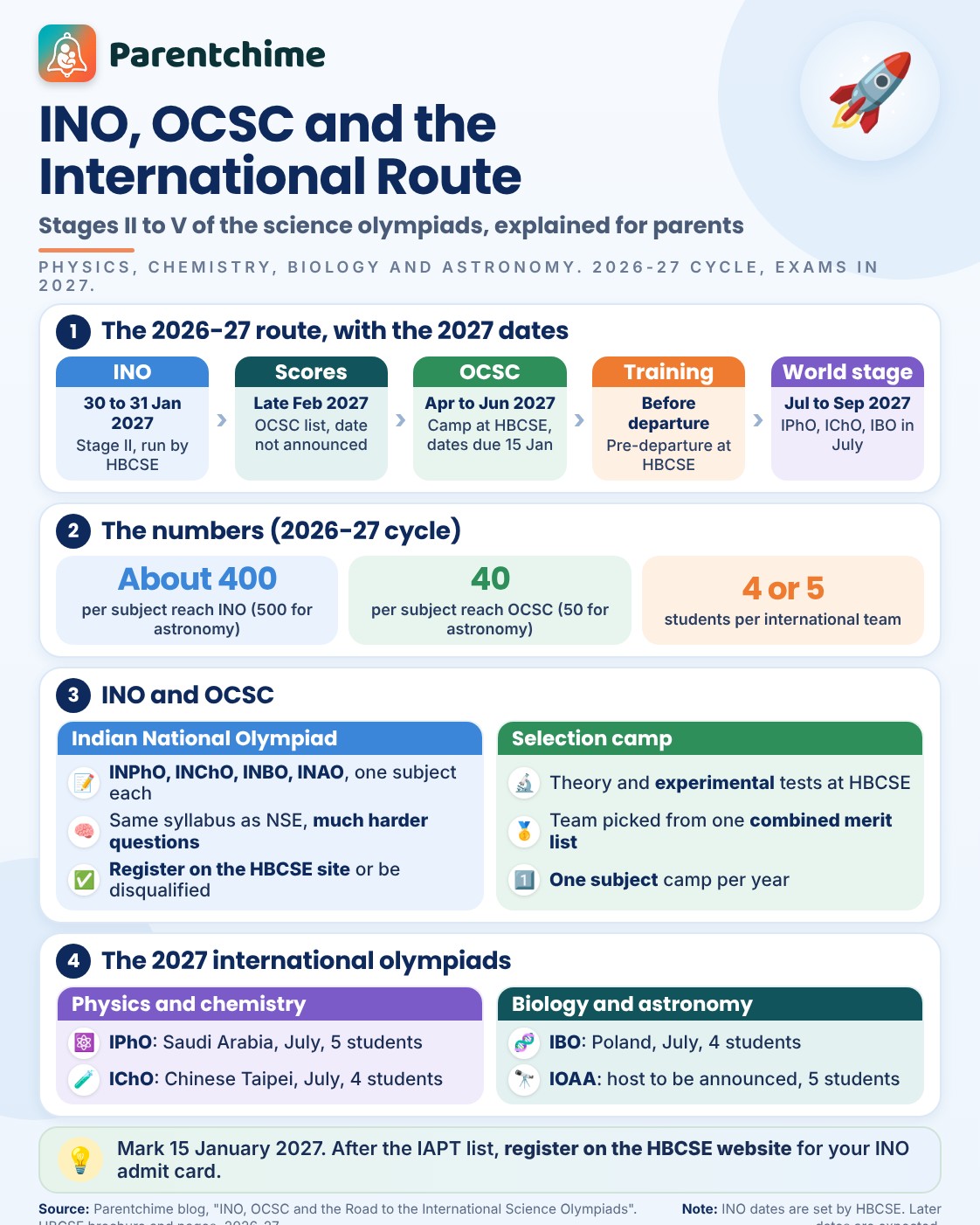
The five stages at a glance
| Stage | What it is | Who runs it | Roughly how many go through |
|---|---|---|---|
| I | National Standard Examination (NSE) | IAPT | Many students write it |
| II | Indian National Olympiad (INO) | HBCSE | About 400 per subject (500 for astronomy) |
| III | Orientation-cum-Selection Camp (OCSC) | HBCSE | 40 per subject (50 for astronomy) |
| IV | Pre-departure training | HBCSE | The selected team |
| V | International Olympiad | The host country | 4 or 5 students per subject |
The ladder gets steep fast. Going from 400 students to 4 or 5 on a team means the work from here on is about depth, stamina and enjoying hard problems, far more than about a syllabus.
Stage II: the Indian National Olympiad (INO)
What it is. A separate national paper for each subject: INAO (astronomy), INChO (chemistry), INPhO (physics) and INBO (biology). HBCSE runs it from this stage onward.
When and where. In 2026-27 it is on 30 and 31 January 2027 at about 17 centres, including Mumbai, Delhi, Bengaluru and Chennai. HBCSE lists INAO and INChO on 30 January and INPhO and INBO on 31 January.
What the paper is like. HBCSE says the syllabus is the same as NSE, up to Class 12 under CBSE, but the questions are usually non-conventional and of high difficulty, comparable to the international olympiads. The HBCSE stages page describes a mix of objective and long questions. The brochure does not publish the number of questions or the marks, so please do not trust a coaching site that quotes them as fixed.
Who qualifies from NSE. The brochure sets a target per subject, in each of two groups. Group A is Class 12 and Group B is Class 10 or 11, as on 30 November 2026.
- Targets: 200 students per group in physics, chemistry and biology, and 250 per group in astronomy. That makes about 400 (or 500) per subject.
- A minimum score: a student must score at least half the average of the top ten NSE scores in the subject, rounded down.
- Automatic entry: a score of 80 percent of that top-ten average or more qualifies on its own.
- State representation: at least 4 students per State or Union Territory, based on the old NTSE quota.
- Girls: at least 20 percent of the selected students per subject, applied only where the share is not already met and the score floor is cleared.
- Previous international team members: students who already represented India in that subject can skip NSE.
The deadline parents miss. Once the shortlist is published on iapt.org.in (by 15 January in 2026-27), the student must register on the HBCSE website to receive an INO admit card. HBCSE states that skipping this means disqualification.
Results and re-evaluation. In 2025-26 the INO was on 31 January and 1 February 2026. HBCSE posted scores and the OCSC list around 21 February, and accepted re-evaluation requests until 26 February. The 2026-27 brochure does not describe a re-evaluation process, so watch the HBCSE site after the exam.
Stage III: the Orientation-cum-Selection Camp (OCSC)
Who goes. The top INO performers. For 2026-27 the brochure gives these numbers:
- Physics, chemistry and biology: 20 from Group A and 20 from Group B, 40 in all.
- Astronomy: 15 from Group A and 35 from Group B, 50 in all.
- Ties at the last position are included.
What happens there. The camp is held at HBCSE in Mumbai, and the HBCSE stages page places it between April and June. Students get orientation in theory and experiments (and observational astronomy for astronomy), and take several theory and practical tests. The brochure does not give the exact camp dates or length. It says dates are announced on the HBCSE website by 15 January and that camps are scheduled to avoid the big national entrance exams where possible.
How the team is picked. From a combined merit list of all camp students in that subject, not from the Group A and Group B split. Camp students receive merit awards in books and cash, with special prizes for theory and for experiments.
One subject per year. A student can attend only one subject's camp in a year, chosen by the preference they state.
Certificate of Merit. Any student whose INO score is at or above the last selected camp student's score gets a certificate, even without a camp place.
Stage IV and V: training and the international olympiad
The selected team trains at HBCSE in theory and experiments, using special labs, with resource persons from institutions across the country. The length of training can be capped by each international olympiad's own rules.
For 2027, the brochure lists:
| Olympiad | Students | Leaders | Host | Month |
|---|---|---|---|---|
| 57th IPhO (physics) | 5 | 2 | Saudi Arabia | July 2027 |
| 59th IChO (chemistry) | 4 | 2 | Chinese Taipei | July 2027 |
| 38th IBO (biology) | 4 | 2 | Poland | July 2027 |
| 20th IOAA (astronomy) | 5 | 2 | To be announced | August or September 2027 |
How Indian teams have done lately. In July 2026, all five members of the Indian physics team won gold at the 56th IPhO in Bucaramanga, Colombia, and India shared the top rank. All four chemistry students won gold at the 58th IChO in Tashkent, which news reports and HBCSE call India's best result there. In biology, the 37th IBO in Vilnius brought one gold and three silver medals.
Each team travels with two leaders, and every member needs an Indian passport valid for at least six months beyond the olympiad dates.
Who can enter this route
The eligibility rules start at NSE and carry through every stage. For the 2026-27 cycle:
- Class 10, 11 or 12 at enrolment, born between 1 July 2007 and 30 June 2012.
- Eligible to hold an Indian passport.
- Living and studying in India, or in the Indian school system, since 30 November 2024 or earlier.
- Not having started university by 1 June 2027, and not completing Class 12 before 30 November 2026.
- Not appearing in NSEJS 2026 at the same time.
- OCI students are provisionally eligible up to and including OCSC but not for the Indian team, under court orders, and HBCSE says this may be revised.
The birth-date windows move forward about a year at a time, so expect the 2027-28 window to start around 1 July 2008. Please confirm in the new notice.
The calendar: last cycle and the likely 2027-28 window
| Step | 2026-27 | Likely in 2027-28 (not announced) |
|---|---|---|
| NSE | 21 and 22 November 2026 | Late November 2027 |
| INO shortlist on iapt.org.in | By 15 January 2027 | Around mid-January 2028 |
| INO admit card registration on HBCSE site | After the list is out | Mid to late January 2028 |
| INO | 30 and 31 January 2027 | Around the last weekend of January 2028 |
| Scores and OCSC list | Not yet announced (about 21 February in 2025-26) | Around late February 2028 |
| OCSC | Dates due by 15 January 2027 (HBCSE places camps between April and June) | April to June 2028 |
| International olympiads | July to September 2027 | July to August 2028, hosts not yet announced |
If your child is in the 2026-27 cycle right now: check iapt.org.in for the INO list by 15 January 2027, register on the HBCSE website straight away, and watch the HBCSE page for OCSC dates.
How to prepare for INO
HBCSE does not publish a preparation plan, so this is general guidance rather than an official one.
Fix the NCERT and NSE base first. INO uses the same syllabus as NSE. What changes is the style of problem, so shaky basics will show up quickly.
Practise long-form problem solving. Unlike a school test, INO questions often need several steps and original reasoning. Encourage your child to work a problem for a while before looking at a solution.
Work with past papers. Ask your child's teacher or mentor for earlier INO and NSE papers, and check the HBCSE olympiad site for what has been posted.
Do practicals if the subject has them. Physics, chemistry and biology camps include experimental tests, and astronomy includes observation. Time spent with real equipment pays off.
Choose one subject. The camp allows only one, so a child who focuses early gains more than one who spreads thin.
Guard the joy. Selection at this level is intensely competitive, and many excellent students will not make the team. Treat INO as a rare chance to see how far curiosity can go, and keep the school year and rest protected.
A year plan for the 2027-28 cycle
- Now to May 2027 (for NSE 2027): build NCERT depth in one subject, and start solving harder problems after school topics.
- June to September 2027: ask the school about NSE enrolment and read the IAPT notice when it appears.
- October to November 2027: timed practice for NSE, then NSE in late November.
- December 2027: keep problem solving going while you wait for the list.
- Mid-January 2028: check iapt.org.in and register on the HBCSE website at once.
- Late January 2028: INO.
- February to June 2028: if selected, OCSC and then pre-departure training.
What is not published
To keep this guide honest, here is what HBCSE does not state in its 2026-27 brochure: the number of INO questions and marks, which subject sits in which time slot for each INO day, the exact OCSC dates and length, the 2027 IOAA host, and any re-evaluation process. Check the HBCSE site as the date nears, and write to scioly@hbcse.tifr.res.in with questions.
Where to check current details
- HBCSE Science Olympiad 2026-27 page
- HBCSE brochure 2026-27
- HBCSE stages of the science olympiad
- IAPT for NSE and the INO shortlist
Comments
No comments yet. Be the first to share what worked for your family.