
Vidyarthi Vigyan Manthan, shortened to VVM, is an online science talent search for students in Classes 6 to 11. It is organised by Vijnana Bharati (VIBHA) in collaboration with NCERT and the National Council of Science Museums (NCSM), and CBSE has circulated information about it to schools.
Registration for 2026-27 has closed and Level 1 took place from 16 to 21 November, so this guide serves two kinds of families: those whose child just sat the exam and are waiting for results, and those who want to plan for 2027-28. The 2027-28 dates are not announced yet, so we show last cycle's dates and the likely window.
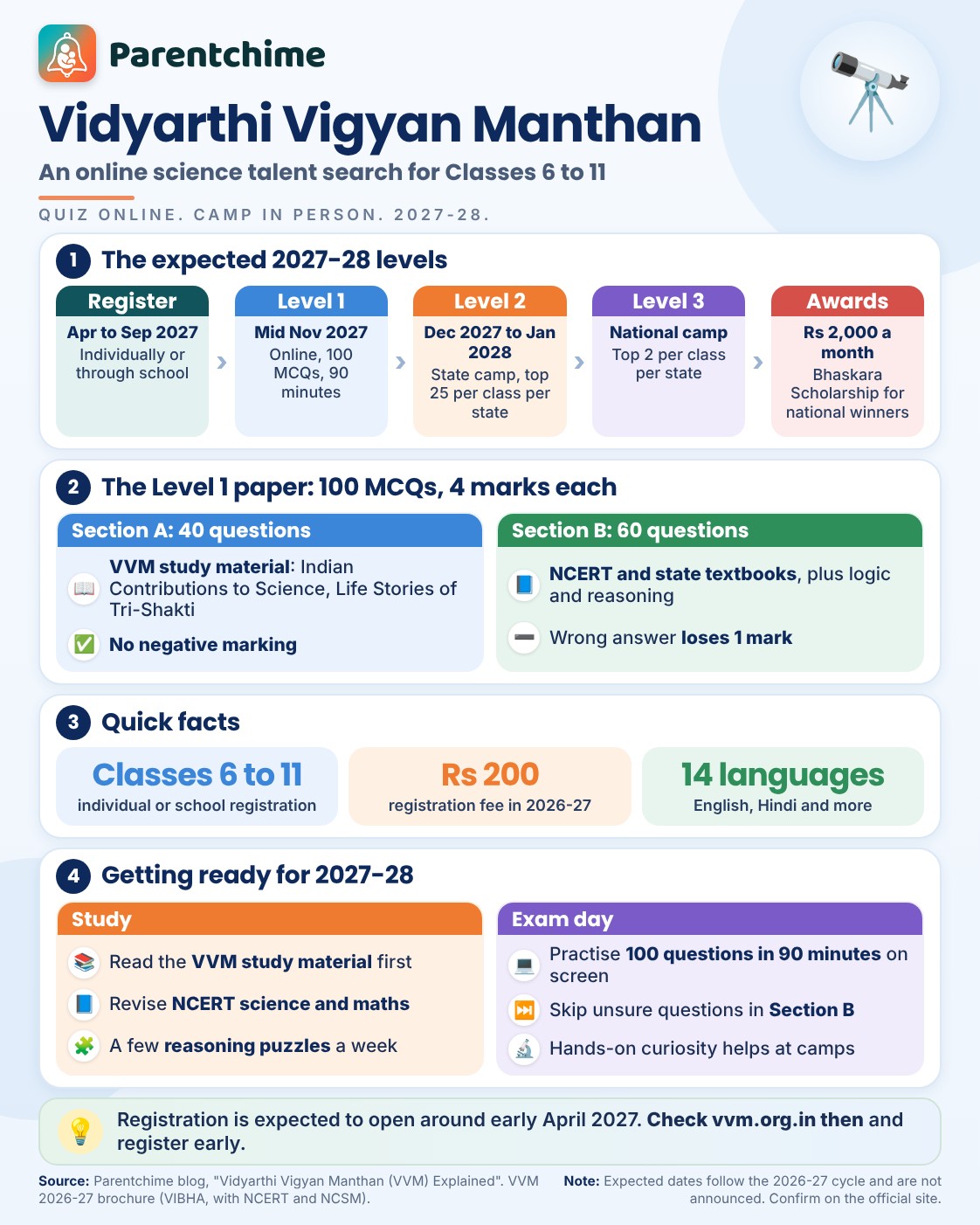
Dates: last cycle and likely 2027-28
| Step | 2026-27 (last cycle) | Likely in 2027-28 (not announced) |
|---|---|---|
| Registration opens | 3 April 2026 | Around early April 2027 |
| Registration closes | 30 September 2026 (some regions to 15 October) | Around the end of September 2027 |
| Level 1, online | 16 to 21 November 2026 | Mid to third week of November 2027 |
| Level 1 results | 30 November 2026 | Around the end of November 2027 |
| Level 2, state camps | Reported as 27 December 2026 or 3, 10 or 17 January 2027 | Around late December 2027 to January 2028 |
If your child sat Level 1 this month: results are due on 30 November 2026 on vvm.org.in, and state camp dates should be confirmed with the organisers.
How the levels work
Level 1: online exam. In 2026-27 it was conducted class-wise on two possible days, 16 or 19 November for Classes 6 and 7, 17 or 20 November for Classes 8 and 9, and 18 or 21 November for Classes 10 and 11. A student can log in only once, between 10:00 AM and 6:00 PM on the chosen day. Results are due on 30 November 2026.
Level 2: state camp. The top 25 rankers in each class in each state are invited to a one-day or two-day camp within the state. The brochure lists application-based multiple-choice questions, hands-on activities, observation and analysis, and situational problem-solving. A preparation site reports the 2026-27 state camps for 27 December 2026 or 3, 10 or 17 January 2027, so confirm your date with the organisers.
Level 3: national camp. The top two students from each class in each state, which is 12 per state, are invited. The two-day camp includes presentations, activities testing scientific understanding, innovation and creativity, leadership assessment and an experimental skill test.
What the Level 1 paper looks like
The paper has 100 multiple-choice questions worth 4 marks each, in 1 hour 30 minutes. It has two sections:
- Section A (40 questions): based on study material provided by Vijnana Bharati, namely Indian Contributions to Science and Life Stories of Tri-Shakti (about Anna Mani, Asima Chatterjee and Rohini Godbole). No negative marking.
- Section B (60 questions): based on the VVM syllabus, drawn from NCERT and state board textbooks, plus logic and reasoning. A wrong answer loses 1 mark.
Study material comes in three volumes: Volume I for Classes 6 and 7, Volume II for Classes 8 and 9, and Volume III for Classes 10 and 11. The detailed syllabus is on vvm.org.in.
What winners receive
The brochure lists a Bhaskara Scholarship of Rs 2,000 per month for one year for national (Himalayan) winners, felicitation for successful state and national students, and exposure visits to research institutions. National and zonal winners also receive a one- to three-week training-cum-internship at institutions such as DRDO, ISRO, CSIR, BARC, IITs, IISERs and NITs.
How to prepare for 2027-28
Read the VVM study material first. Since Section A is built entirely on it, this is the most direct way to earn marks. The stories of Indian scientists make easy reading for a child, so it can be a family activity.
Revise NCERT science and maths. For Section B, school textbooks are the base. Revising chapter by chapter, with short notes, is enough for most children.
Practise reasoning. A few puzzles a week, as in other talent-search exams, build speed.
Mind the negative marking in Section B. Teach your child to skip a question they cannot narrow down, and to attempt every question in Section A.
Do a trial run on a screen. Practise 100 questions in 90 minutes on a computer so the format feels familiar. Check the technical requirements before exam day, since login is allowed only once.
Encourage hands-on curiosity. The camps reward activity, observation and teamwork, so simple experiments at home are good practice.
A year plan for 2027-28
- Now to March 2027: keep up with NCERT science and maths, and read the study material once the 2027-28 version appears.
- April 2027: registration is expected to open. Register, individually or through the school.
- May to September 2027: one volume of the study material at a relaxed pace, plus a few reasoning puzzles a week.
- October 2027: two timed screen-based practice tests of 100 questions in 90 minutes.
- Mid-November 2027: Level 1, expected around the same time as this year.
- Late December 2027 to January 2028: state camps for the top 25 in each class, if your child qualifies.
What parents can do
- Put a reminder in your calendar for early April 2027 to check vvm.org.in for registration, and for the end of September as the likely close.
- Ask your school whether it registers students as a group.
- Keep the mood light. VVM is a good first talent-search exam for a child new to this kind of test.
Comments
No comments yet. Be the first to share what worked for your family.