
NMMS is a scholarship exam rather than a competition for trophies. Its aim, as the Ministry of Education describes it, is to help meritorious students from lower-income families continue their studies after Class 8. If your child studies in a government or government-aided school, it is one of the most valuable exams to know about.
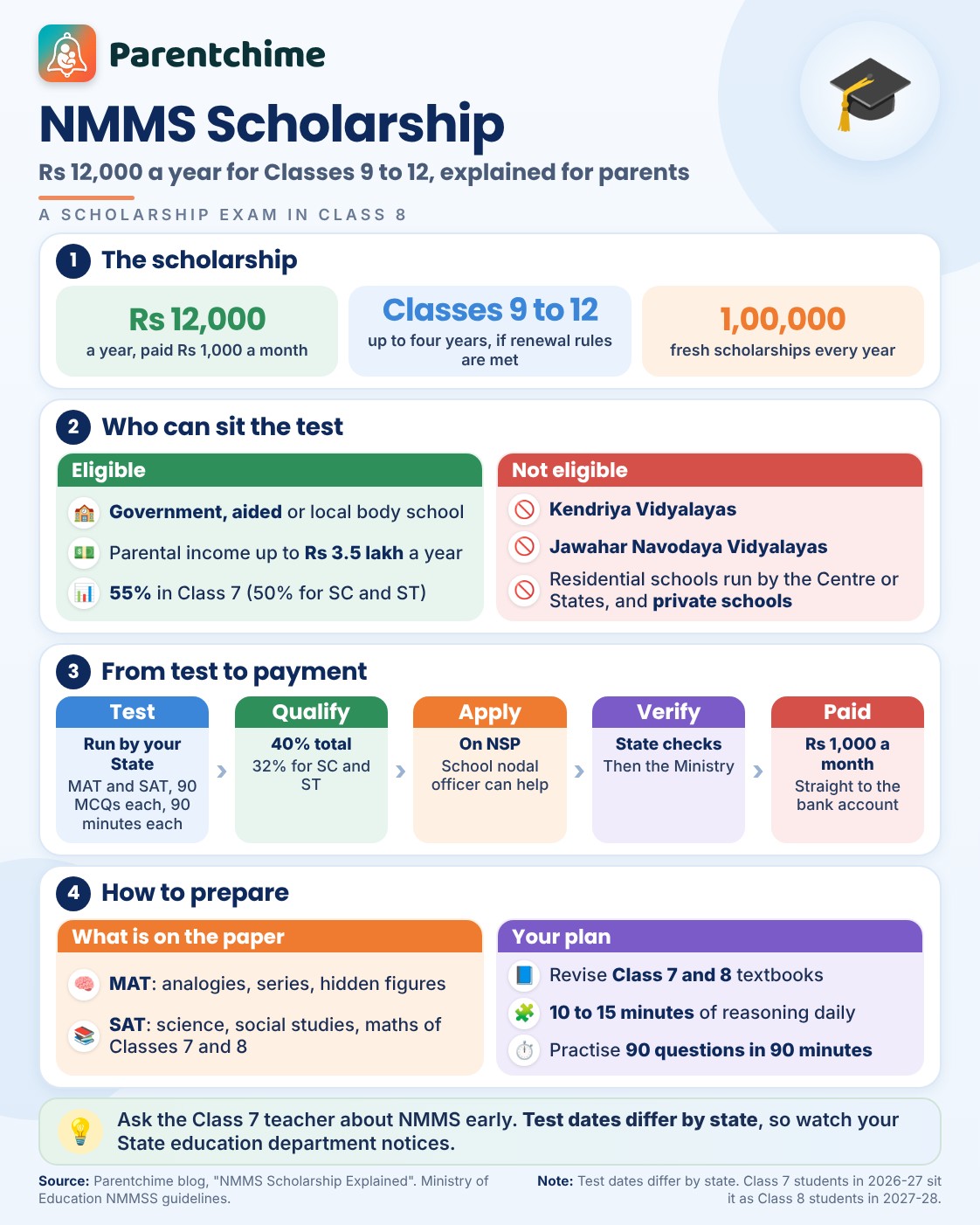
The scheme awards about 1,00,000 fresh scholarships every year at the Class 9 level, at Rs 12,000 per year (Rs 1,000 per month), and it can run up to Class 12.
Who can sit the NMMS test
According to the Ministry of Education guidelines, a student must:
- Be a regular student in a government, government-aided or local body school
- Have parental income of not more than Rs 3,50,000 per year from all sources
- Have scored at least 55% (or equivalent) in Class 7 to sit the test, with a 5% relaxation for SC and ST students
Students of Kendriya Vidyalayas, Jawahar Navodaya Vidyalayas, residential schools run by the Centre or States, and private schools are not eligible.
What the test looks like
Each State or UT conducts its own selection test. The guidelines describe two papers, each with 90 multiple-choice questions and 90 minutes:
- Mental Ability Test (MAT): verbal and non-verbal reasoning and critical thinking, such as analogies, classification, number series and hidden figures.
- Scholastic Aptitude Test (SAT): science, social studies and mathematics from Classes 7 and 8.
To qualify, a student needs at least 40% in aggregate across both tests, or 32% for SC and ST students. The 1,00,000 scholarships are shared among states and UTs, weighted mostly by Class 7 and 8 enrolment, so the number of seats depends on where you live. Reservation follows each State or UT's own rules.
Test dates vary a good deal from state to state, so ask your school or check your State education department for the notice.
After selection
Selected students apply through the National Scholarship Portal (NSP). The state government verifies the application before it goes to the Ministry, and payment goes straight to the student's bank account. Schools have a nodal officer who can help with the NSP form.
To keep the scholarship going, the guidelines set conditions such as clearing promotions from Class 9 to 10 and Class 11 to 12 on the first attempt, joining the next class within three months of the previous result, and scoring at least 60% in Class 10 (with a 5% relaxation for SC and ST students). A gap of a full academic session ends the scholarship. Read the current guidelines with your school, because these rules can be revised.
How to prepare
Treat it as two skills. One half of the paper is reasoning and the other half is school content. Train both.
Revise Class 7 and 8 properly. Use the school textbooks and go chapter by chapter in science, social studies and maths. Make short notes your child can flip through before the test.
Practise reasoning a little each day. Ten to fifteen minutes on series, analogies, patterns and figure puzzles builds speed, and it is easy to keep up alongside school.
Use previous state papers. Your school or State education department may have past papers. Sit one under a 90-minute timer.
Pay attention to time. With 90 questions in 90 minutes, there is about a minute per question. Teach your child to move on and return later.
Prepare the paperwork early. The income certificate and bank account can take time to arrange. Ask the school what is needed.
A year plan for the 2027-28 cycle
Since the Class 7 marks decide who can sit, the plan starts earlier than most parents expect:
- Class 7 (2026-27, now): aim to keep marks comfortably above 55% (50% for SC and ST). Ask the class teacher about NMMS before Class 8 starts.
- Start of Class 8 (2027-28 school year): ask the school for your state's NMMS notice and test date. States set their own, so no single national date exists.
- Paperwork, early in Class 8: ask what the school needs for the income certificate and a bank account for the child.
- Class 8 revision: a little reasoning practice each day, and chapter-wise revision of Class 7 and 8 school subjects.
- After selection: apply through the National Scholarship Portal with the school's nodal officer.
What parents can do
- Ask the class teacher in Class 7 about NMMS so your child does not miss the window.
- Keep Class 7 marks above the cut-off, since that decides who can sit the test.
- Check all state dates and rules on official notices.
Where to check current details
- NMMSS guidelines, Ministry of Education
- MyScheme page for NMMSS
- Your State education department or SCERT website for the test date
Comments
No comments yet. Be the first to share what worked for your family.