
If your child is the one who keeps asking for "one more puzzle", the Indian Olympiad Qualifier in Mathematics, or IOQM, is where the national maths olympiad route begins. It is the first stage on the path that eventually selects India's team for the International Mathematical Olympiad.
This guide walks through how the pathway works, how many students move from one stage to the next, and how a family can prepare in a way that keeps the subject fun. The dates below come from the 2026-27 cycle, which is nearly over. Where the 2027-28 dates are not announced yet, we give the likely window based on last year and say so. For the bigger picture of every kind of olympiad, start with our guide to olympiad exams in India. If you are still deciding whether your child should sit any of them, our pros and cons list may help.
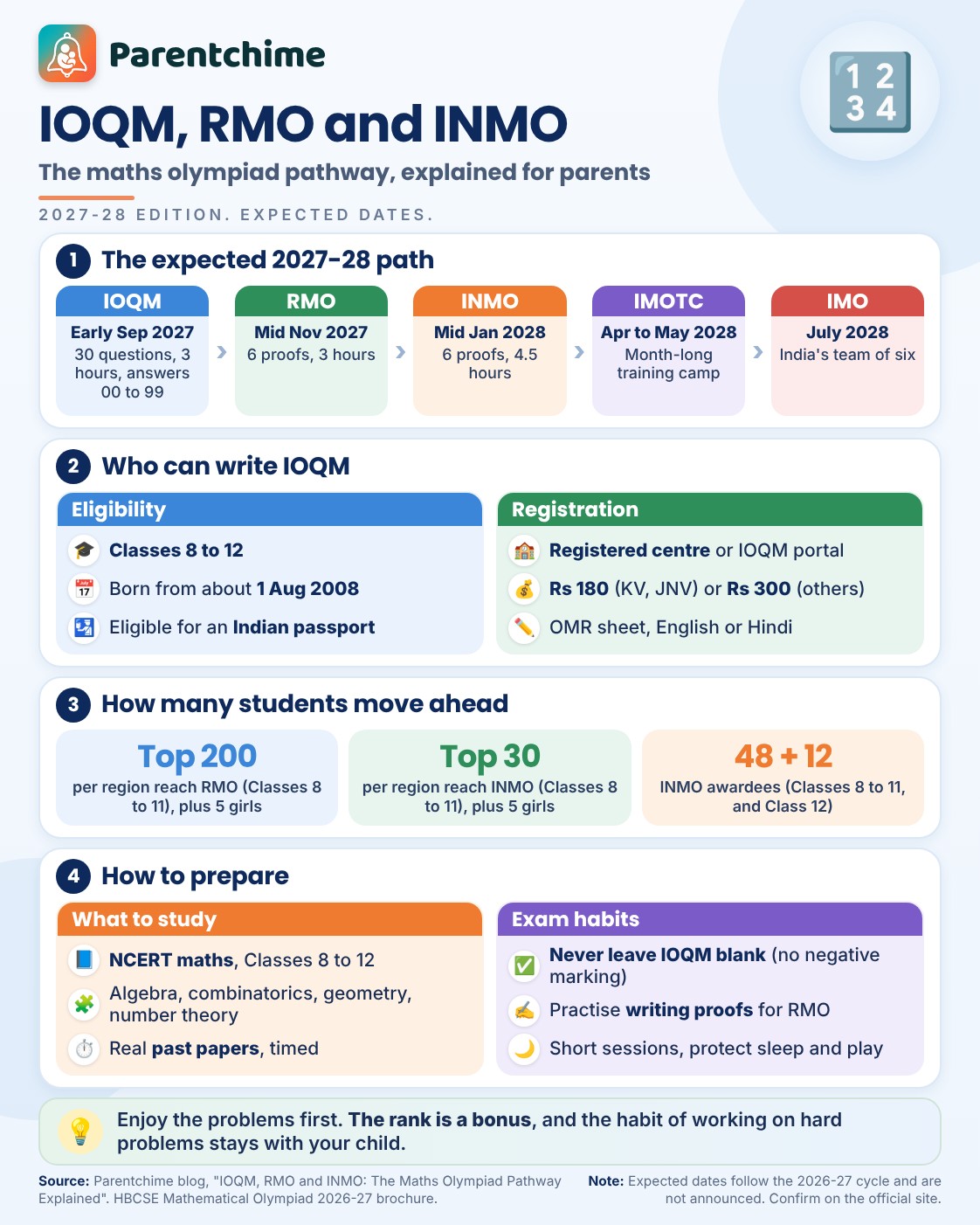
The pathway at a glance
| Stage | 2026-27 (last cycle) | Likely in 2027-28 (not announced) |
|---|---|---|
| IOQM, first stage | 6 September 2026 | Early September 2027 |
| RMO (Regional Mathematical Olympiad) | 15 November 2026 | Mid-November 2027 |
| INMO (Indian National Mathematical Olympiad) | 17 January 2027 | Mid-January 2028 |
| IMOTC (training camp for INMO awardees) | April and May 2027 | April and May 2028 |
| IMO | July 2027 | July 2028 |
The IMO is held every July in a different country, with a team of the six best students from the camp. The HBCSE brochure also describes a separate route for girls to the European Girls' Mathematical Olympiad (EGMO), with a training camp in December 2027.
If your child is already in the 2026-27 cycle: INMO is on 17 January 2027 for those who cleared RMO, and the camp follows in April and May. Everyone else can use the months ahead as a head start.
Who can write IOQM
These are the 2026 cycle rules, which are the best guide to 2027. The dates in them move forward by about a year, so check the new brochure when it comes out. A student needed to be:
- Studying in Classes 8 to 12 and born between 1 August 2007 and 31 July 2014
- Eligible to hold an Indian passport (OCI students may write provisionally but cannot be selected for the international teams)
- Living in India, or studying in the Indian school system, since 30 October 2024 or earlier
- Not on track to take the Class 12 board exam before 30 October 2026, and not starting university by 1 June 2027
Registration works through a registered centre, or individually through the IOQM portal. The portal asks for a passport-size photo, a school ID or recent fee receipt, and an identity document such as an Aadhaar card, passport or birth certificate. The 2026-27 fee listed there was Rs 180 for Kendriya Vidyalaya and Jawahar Navodaya Vidyalaya students and Rs 300 for everyone else.
What each stage looks like
IOQM is a three-hour paper with 30 questions. Every answer is a whole number from 00 to 99, marked on an OMR sheet. The first ten questions carry 2 marks each, the next ten carry 3 marks each and the last ten carry 5 marks each, for 100 marks in total. There is no negative marking.
RMO is a three-hour exam with six problems worth 17 marks each, and every answer is a written proof. This is the stage where many students meet proof-writing for the first time.
INMO is four and a half hours, again six proof problems worth 17 marks each. HBCSE says difficulty rises from RMO to INMO to the IMO itself.
IMOTC invites the INMO awardees to a month-long camp. Selection tests during the camp pick the six students who represent India at the IMO.
How many students move ahead
It helps to go in with realistic expectations. The 2026-27 brochure set these numbers, and they are a reasonable guide to 2027-28:
- IOQM to RMO: a student needs at least 10% of the total marks, and then must be among the top 200 in their region (Category A, Classes 8 to 11) or the top 40 (Category B, Class 12). Five extra girls from Category A are added.
- RMO to INMO: the top 30 per region in Category A and the top 6 in Category B, plus five extra girls from Category A.
- INMO awardees: the top 48 from Classes 8 to 11 and the top 12 from Class 12. Awardees can go directly to INMO the following year.
Every student who scores at least 10% on IOQM receives a certificate. For most children, the real reward is the habit of working on hard problems, and anything beyond that is a bonus.
What the syllabus asks for
HBCSE says aspirants must be familiar with the topics in the NCERT mathematics books for Classes 8 to 12. The questions come from four areas: algebra, combinatorics, geometry and number theory. Expect questions that combine familiar ideas in unfamiliar, multi-step ways.
How to prepare, step by step
Start with curiosity. In Classes 6 to 8, puzzles, logic games and "why does this work?" conversations do more good than formal drilling.
Get the NCERT foundation solid. Because the syllabus statement is anchored to NCERT, a child who is shaky on school maths will find olympiad problems frustrating. Fix the base first.
Work through the four areas one at a time. Spend a few weeks each on number theory, algebra, geometry and combinatorics, rather than skimming all four together. Combinatorics and number theory are often unfamiliar to school students, so give them extra time.
Use real past papers. HBCSE lists past papers and sample questions on its website. Sitting one paper under timed conditions, three hours with no breaks, tells you more than a month of random practice.
Never leave an IOQM question blank. Since there is no negative marking, an educated guess costs nothing.
Learn to write a proof. For RMO, a correct answer without reasoning earns little. Ask your child to explain a solution aloud first, then write it out in clean steps.
Keep it light. A few short sessions a week beat one marathon on Sunday. Books such as Challenge and Thrill of Pre-College Mathematics and Problem Primer for the Olympiad are often recommended by teachers and prep sites, though HBCSE itself does not prescribe a book list on its site.
A year plan for the 2027-28 cycle
Counting back from an early September IOQM, here is a calm plan that suits a child starting from school-level maths:
- Now to March 2027: firm up NCERT maths for the current class. Add one fun puzzle a week.
- April to June 2027: pick one of the four areas, usually number theory or combinatorics, and spend a few weeks on it. Check ioqm.mtai.org.in for registration news.
- July 2027: register, then solve one timed IOQM past paper every two weeks.
- August 2027: one full three-hour paper a week. Review every mistake.
- Early September 2027: IOQM. Attempt every question, since there is no negative marking.
- October and November 2027: for those who qualify, proof-writing practice for RMO in mid-November.
- January 2028: INMO for those who clear RMO.
What parents can do
- Put the IOQM dates in your calendar once HBCSE and MTA(I) publish them, since they shift every year.
- Sit with your child for the first few problems and show interest in the thinking, not just the answer.
- Celebrate a clever failed attempt as much as a correct one.
- Protect sleep, play and school time. A rested child solves better.
- Check dates on the official sites, because they shift every year.
Where to check current details
- HBCSE Mathematical Olympiad page
- IOQM portal
- HBCSE Mathematical Olympiads contact: matholy@hbcse.tifr.res.in
Comments
No comments yet. Be the first to share what worked for your family.