
Most competitions ask a child to sit an exam. INSPIRE-MANAK asks a child to come up with an idea. If your child is the sort who tinkers, sketches gadgets or says "someone should invent a thing for that", this government scheme is worth knowing about.
MANAK stands for Million Minds Augmenting National Aspiration and Knowledge. It sits under INSPIRE, the Department of Science and Technology's flagship programme, and is run with the National Innovation Foundation-India (NIF).
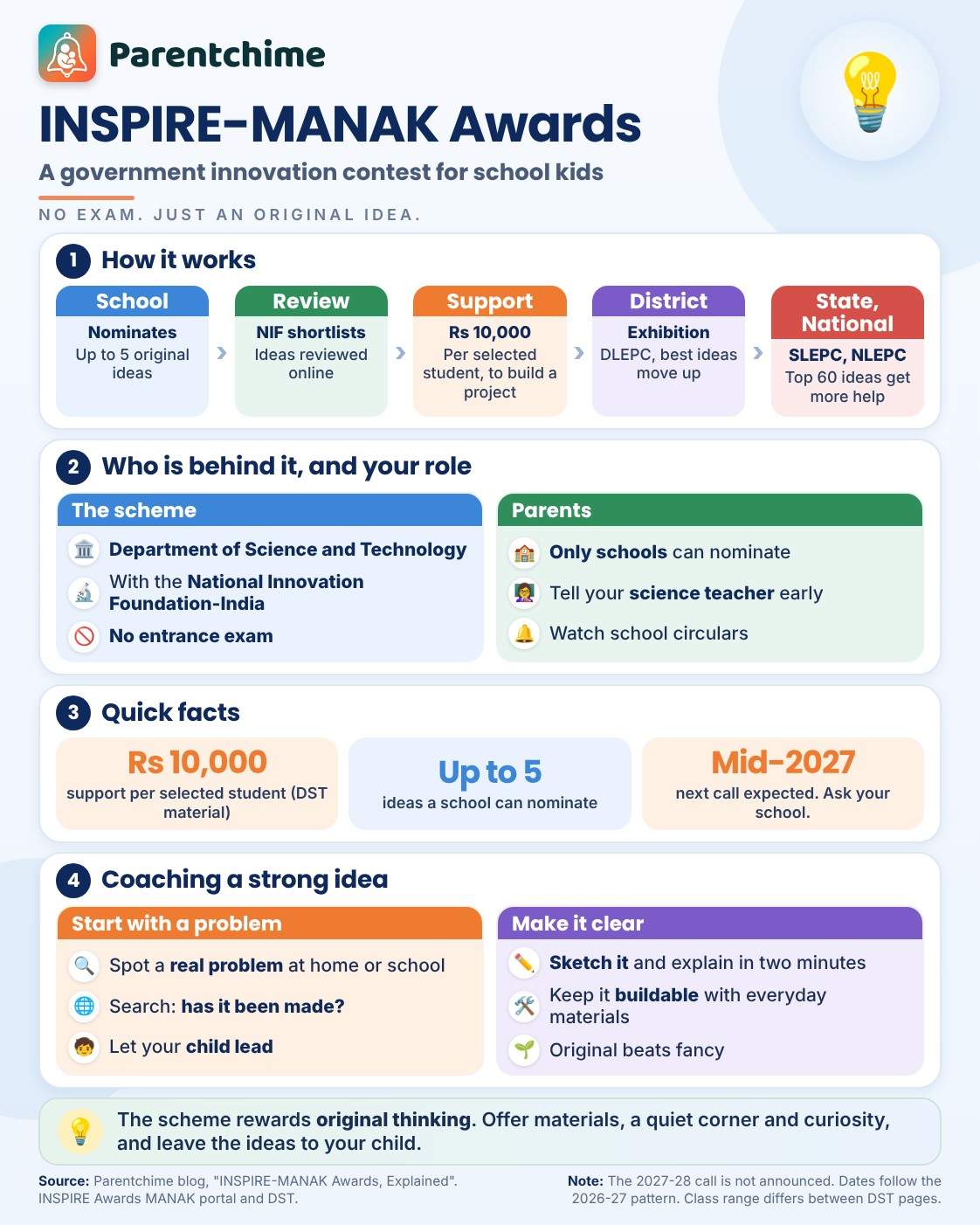
How it works
- The school nominates. Nominations are submitted through the School Authority login on the official portal or the mobile app. The current portal says a school can nominate up to 5 original ideas, with at most 2 from Classes 11 or 12 in the Science stream.
- Ideas are reviewed. Older DST material describes a very large pool of ideas being reviewed online by NIF, with about one lakh shortlisted.
- Shortlisted students receive support. DST material states Rs 10,000 per student to build a project or model.
- Exhibitions follow. Students present at a District Level Exhibition and Project Competition (DLEPC). The best move on to the State Level (SLEPC) and then the National Level (NLEPC).
- The top ideas get further help. DST material describes NIF considering the top 60 ideas for product or process development and linking them with other schemes.
The portal reports that the 12th National Level Exhibition and Project Competition winners were felicitated on 14 October 2026 at Bharat Mandapam in New Delhi, and that nominations for 2026-27 are now closed. The 2027-28 call has not been announced yet, and last year's circular suggests it could come around mid-year.
Eligibility: a quick note
Older government pages describe INSPIRE-MANAK as being for students in Classes 6 to 10, aged 10 to 15. The current portal describes Classes 6 to 12 and ages 10 to 17. Because both versions appear on official sites, the safest move is to ask your school what the latest circular says. CBSE issued a circular on 31 July 2026 about online nominations for 2026-27, which is a useful starting point for CBSE schools. Expect something similar around mid-2027.
What makes a strong idea
The scheme looks for original ideas rooted in science and technology that solve a real problem. Here is a simple way to coach your child without taking over:
- Start with a problem they have noticed. A heavy school bag, wasted water at home, a grandparent who struggles with a medicine box. Ideas that begin with real life tend to be sharper.
- Ask "has someone already made this?" A quick search together teaches research skills and pushes the idea towards something new.
- Sketch it and explain it in two minutes. If your child can explain how it works to a relative, the idea is clear.
- Keep it buildable. A simple working model made from everyday materials is better than a grand plan that cannot be tested.
- Let the child lead. The student's own thinking is what the scheme is designed to reward.
A year plan for the 2027-28 cycle
Nominations are made by schools, so the best use of the months before the call is to help your child gather ideas:
- Now to May 2027: start a "problems I noticed" notebook. One line a week is plenty.
- June to July 2027: pick one idea with your child, search whether it already exists, and sketch it.
- July to September 2027: tell the science teacher, and watch for the school circular. Ask which class teacher coordinates INSPIRE-MANAK.
- After nomination: if the idea is shortlisted, the build phase begins, so keep simple materials ready.
What parents can do
- Tell your child's science teacher that your child is interested, well before nominations open.
- Watch your school's circulars, since schools handle the nomination.
- Offer materials, a quiet corner and curiosity. Leave the ideas to your child.
Comments
No comments yet. Be the first to share what worked for your family.