
Is your child getting enough iron?
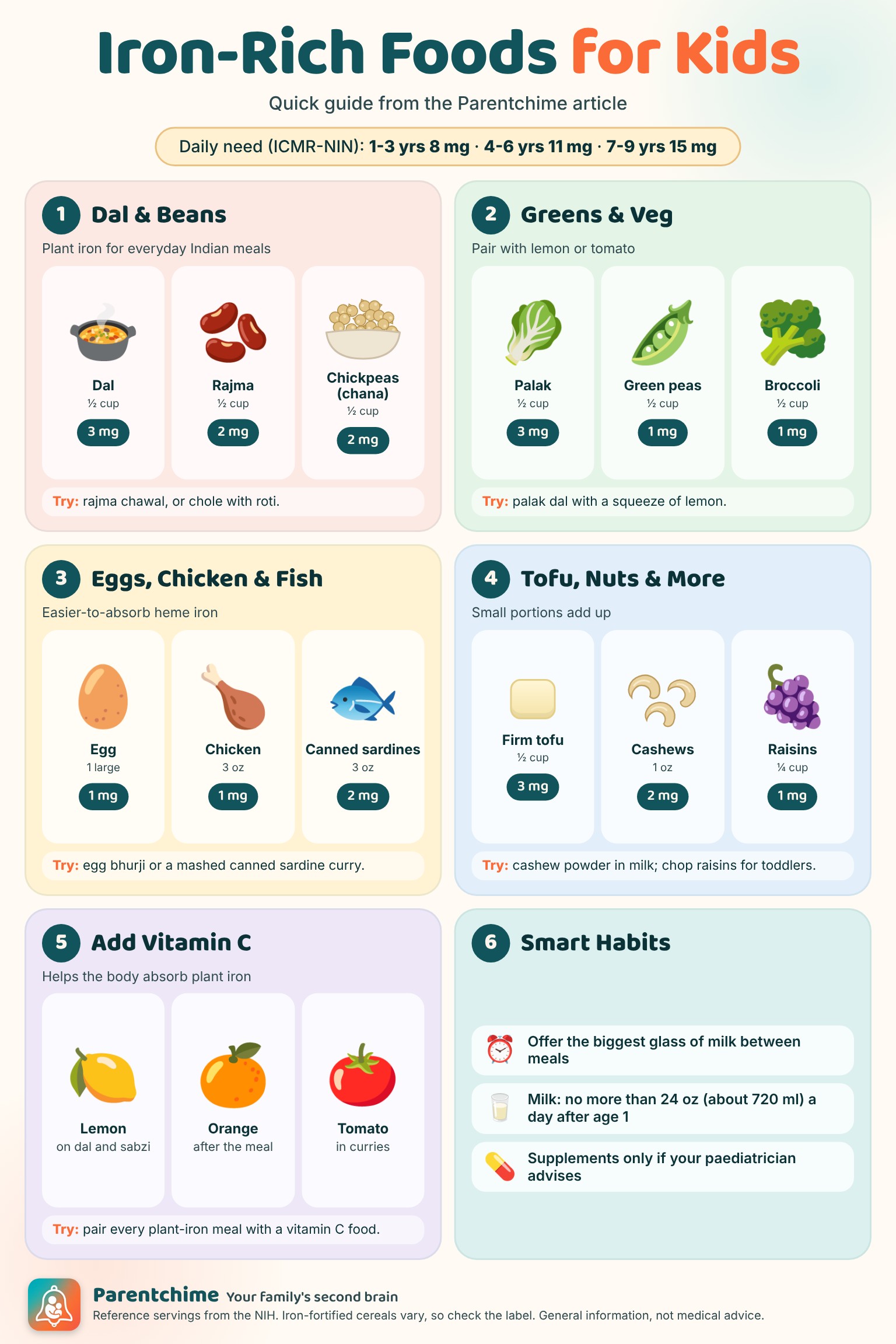
Iron is one of the most important minerals in childhood, and one of the easiest to fall short on. The ICMR-NIN recommends 8 mg a day for a 1 to 3 year old, 11 mg for a 4 to 6 year old and 15 mg for a 7 to 9 year old. Everyday Indian foods such as dal, rajma, chana, palak, eggs and fortified cereals can all help your child get there.
Here is what iron does, how much children need at each age, which foods provide it, and how to make the most of the iron in the meals you already cook.
Why is iron important for children?
Iron helps red blood cells carry oxygen around the body, and growing children need a steady supply.
- Energy and stamina: Low iron can leave a child tired, pale and short of energy.
- Growth: Rapid growth in the first year and during growth spurts raises iron needs, as the American Academy of Pediatrics (AAP) explains.
- Brain development: The World Health Organization (WHO) notes that severe anaemia can lead to poor cognitive and motor development in children.
Iron deficiency is a common concern in India. The fifth National Family Health Survey (NFHS-5, 2019-21) found that 67.1% of children aged 6 to 59 months were anaemic, up from 58.6% in the previous survey. Anaemia has several causes, and the WHO identifies iron deficiency from inadequate dietary iron as the most common nutritional one. That makes everyday meals a good place to start.
How much iron does your child need every day?
Iron requirements change with age and, from adolescence, with sex. For Indian families, the ICMR-NIN gives age-specific recommendations.
| Child's age | Iron requirement per day |
|---|---|
| 6-12 months | 3 mg |
| 1-3 years | 8 mg |
| 4-6 years | 11 mg |
| 7-9 years | 15 mg |
| 10-12 years | Boys: 16 mg; Girls: 28 mg |
| 13-15 years | Boys: 22 mg; Girls: 30 mg |
| 16-18 years | Boys: 26 mg; Girls: 32 mg |
Source: ICMR-NIN, Nutrient Requirements for Indians, 2020. Values are Recommended Dietary Allowances (RDAs), and they are dietary targets rather than supplement doses.
For comparison, the US NIH recommends 11 mg for babies aged 7 to 12 months, 7 mg for ages 1 to 3, 10 mg for ages 4 to 8, 8 mg for ages 9 to 13, and 11 mg for boys and 15 mg for girls aged 14 to 18. The two sets of numbers differ because the underlying assumptions about how much iron the body absorbs differ. The ICMR-NIN figures are set for Indian dietary patterns. The gap is widest for babies and for teenage girls, so ask your paediatrician which figure to aim for if your child is in one of those groups.
Remember: Daily requirements describe intake over time. You do not need to count every milligram at every meal. Offering iron-rich foods regularly, in a balanced diet, is what counts.
Who is more likely to run low on iron?
Some children have a higher chance of falling short, and it helps to know where your child sits.
- Babies from about 6 months. Iron stores from birth start to run down, so iron-rich solid foods or iron-fortified foods matter. The NIH points to the 6 to 9 month window in particular.
- Toddlers. Fast growth, small appetites and fussy phases can make iron hard to fit in.
- Children who drink a lot of milk. The AAP advises no cow's milk before the first birthday and no more than 24 ounces (about 720 ml) a day afterwards.
- Vegetarian and vegan children. Plant iron absorbs less easily, so the NIH sets the requirement about 1.8 times higher for vegetarians.
- Teenage girls. The AAP notes that more than 1 in 10 adolescent girls with periods show signs of iron deficiency.
- Children with certain medical conditions, including sickle-cell disease and inflammatory bowel disease.
Two kinds of iron: heme and non-heme
Food contains iron in two forms, and your child's body treats them differently.
- Heme iron comes from meat, poultry, fish and seafood. It is absorbed more readily.
- Non-heme iron comes from plant foods such as lentils, beans, greens, seeds and fortified foods. Meat and fish contain some non-heme iron too.
The NIH reports that the body absorbs about 14% to 18% of iron from a mixed diet that includes meat, seafood and vitamin C, and about 5% to 12% from a vegetarian diet. Vegetarian families can close much of that gap with the simple habits below.
12 iron-rich foods for kids
Here are 12 useful vegetarian and non-vegetarian options. Servings are the reference sizes used in the NIH food table, which are larger than many children eat in one sitting.
| Food | Reference serving | Iron |
|---|---|---|
| Canned white beans | 1 cup | 8 mg |
| Cooked lentils (dal) | ½ cup | 3 mg |
| Boiled spinach (palak) | ½ cup | 3 mg |
| Firm tofu | ½ cup | 3 mg |
| Cooked kidney beans (rajma) | ½ cup | 2 mg |
| Cooked chickpeas (chana or chole) | ½ cup | 2 mg |
| Oil-roasted cashews | 1 oz (28 g) | 2 mg |
| Baked potato with skin | 1 medium | 2 mg |
| Boiled green peas | ½ cup | 1 mg |
| Seedless raisins | ¼ cup | 1 mg |
| Whole-wheat bread | 1 slice | 1 mg |
| Hard-boiled egg | 1 large | 1 mg |
Source: NIH Office of Dietary Supplements, iron food sources table. Amounts are rounded to the nearest milligram and are approximate. Indian recipes, ingredients, brands and portion sizes vary. These are reference servings and they are not recommended portions for every child.
Best vegetarian iron sources for Indian children
1. Dal and lentils. Moong, masoor, toor and other dals provide iron, protein and fibre. Dal-rice, khichdi, sambar and lentil soup all count.
2. Rajma, chickpeas (chana) and other beans. Chana here means chickpeas, either the pale kind used for chole or brown (kala) chana. The NIH figure is for cooked chickpeas in general, so treat it as a guide. Rajma chawal, chole and chana pulao are easy ways to serve them.
3. Leafy greens. Palak and other greens contribute iron and pair well with dal. Squeeze a little lemon over them.
4. Tofu. Firm tofu is a convenient plant source. Try tofu bhurji as a change from paneer. Milk and cheese are valuable for calcium and protein, and they contribute almost no iron in the NIH table.
5. Nuts, seeds and dried fruit. Cashews, raisins and seeds add small amounts. Grind or chop them finely for young children, because whole nuts and raisins are choking hazards.
6. Iron-fortified cereals. The NIH table lists an iron-fortified breakfast cereal at 18 mg per serving. Fortification varies a great deal between brands, so read the label, and choose cereals with little added sugar.
Other traditional foods, such as ragi, bajra, sesame (til), garden cress seeds (halim), dates and amaranth leaves, also contribute iron to Indian diets. They are not in the NIH table, so no figures are given here. They are good ways to add variety.
Best non-vegetarian iron sources
Animal foods contain heme iron, which the body absorbs more easily.
| Food | Reference serving | Iron |
|---|---|---|
| Pan-fried beef liver | 3 oz (85 g) | 5 mg |
| Braised beef | 3 oz (85 g) | 2 mg |
| Canned sardines | 3 oz (85 g) | 2 mg |
| Roasted chicken | 3 oz (85 g) | 1 mg |
| Roasted turkey breast | 3 oz (85 g) | 1 mg |
| Light tuna canned in water | 3 oz (85 g) | 1 mg |
| Hard-boiled egg | 1 large | 1 mg |
Source: NIH food composition table. These are reference values for specific foods and preparations.
Mutton, lamb and fresh fish such as mathi also fit into a balanced Indian diet. They are not in this table, so they are left out of the totals later in the article. Liver is rich in iron and also very rich in vitamin A, so offer it only occasionally and in small portions.
How to help your child absorb more iron
The iron in a food and the iron the body absorbs can be quite different amounts. A few kitchen habits help.
- Add vitamin C. Vitamin C increases non-heme iron absorption. Lemon on dal, tomato in sabzi, guava or orange slices after a meal, and capsicum in a stir-fry all do the job.
- Pair plant iron with a little animal protein if your family eats it. Meat, poultry and fish increase non-heme iron absorption too.
- Go easy on bran at iron-rich meals. The WHO lists bran as a food that slows absorption, so save bran-heavy foods for other times of day.
- Space out milk. The NIH notes that calcium may reduce iron absorption, although this is not firmly established, and the WHO suggests limiting calcium at iron-rich meals. Offer the biggest glass of milk between meals.
- Soak and cook legumes well. Phytates in grains and beans reduce iron absorption, and the NIH notes that a typical mixed diet softens the effect.
Simple iron-rich Indian meal ideas for kids
You do not need a separate iron diet. Small additions to familiar meals do the work.
| Meal | Easy ideas |
|---|---|
| Breakfast | Egg bhurji with toast; vegetable poha with peas and a few orange segments; iron-fortified cereal |
| Mid-morning | Boiled chana; a small handful of chopped raisins; guava |
| Lunch | Dal and palak with roti; chole with roti; chicken curry with dal |
| Evening snack | Cashew powder stirred into milk or kheer; hummus with bread sticks |
| Dinner | Rajma with roti; tofu bhurji; fish curry with a side of greens |
Example: A 4 to 6 year old who has dal and palak at lunch, an egg at breakfast and chana as a snack gets iron from several sources before dinner even starts.
3-day vegetarian meal plan
This plan uses plant foods only, with a vitamin C food built into most meals. Iron figures come from the NIH reference servings in the tables above. Foods without a published value in that table, such as roti, poha, rice and paneer, are left out of the totals, so the real number will be a little higher.
Day 1: Dal and greens
| Meal | What to serve | Iron |
|---|---|---|
| Breakfast | Vegetable poha with green peas (½ cup) and orange segments | 1 mg |
| Lunch | Dal (½ cup) and palak sabzi (½ cup) with roti and a squeeze of lemon | 3 mg + 3 mg |
| Snack | Chopped raisins (¼ cup) with a bowl of curd | 1 mg |
| Dinner | Rajma (½ cup) with roti and cucumber | 2 mg |
| Day total | about 10 mg |
Day 2: Chickpeas, tofu and a vitamin C boost
| Meal | What to serve | Iron |
|---|---|---|
| Breakfast | Aloo sandwich on 2 slices of whole-wheat bread, with a medium potato filling, and guava slices | 2 mg + 2 mg |
| Lunch | Chole (½ cup) with roti and a tomato-onion salad | 2 mg |
| Snack | Cashew powder (1 oz of cashews) stirred into warm milk | 2 mg |
| Dinner | Tofu bhurji (½ cup firm tofu) with roti and steamed broccoli (½ cup) | 3 mg + 1 mg |
| Day total | about 12 mg |
Day 3: Sambar, pulao and soup
| Meal | What to serve | Iron |
|---|---|---|
| Breakfast | Idli with sambar made with dal (½ cup) | 3 mg |
| Lunch | Chana pulao with chickpeas (½ cup) and peas (½ cup) | 2 mg + 1 mg |
| Snack | Chopped raisins (¼ cup) and an orange | 1 mg |
| Dinner | Lentil soup (½ cup) with a slice of whole-wheat toast | 3 mg + 1 mg |
| Day total | about 11 mg |
Kitchen habits built into this plan
- Vitamin C at the table: Orange, guava, lemon and tomato appear on most days, so plant iron is easier to absorb.
- Mixed plates: Every day combines a legume with a vegetable, so no single food carries the load.
- Milk between meals: The biggest glass of milk sits at snack time, away from the iron-rich meals.
- Safe textures: Chop or grind cashews and raisins finely for toddlers.
3-day non-vegetarian meal plan
This plan brings in heme iron from animal foods alongside dal and vegetables. Mutton, lamb and fresh fish can be swapped in, although they are left out of the totals because the NIH table does not list them.
Day 1: Egg, chicken and canned sardines
| Meal | What to serve | Iron |
|---|---|---|
| Breakfast | Egg bhurji (1 egg) with a slice of whole-wheat toast | 1 mg + 1 mg |
| Lunch | Chicken curry (3 oz chicken) with dal (½ cup) and rice | 1 mg + 3 mg |
| Snack | Chopped raisins (¼ cup) | 1 mg |
| Dinner | Canned sardines (3 oz) mashed into a curry or served on toast, with palak (½ cup) and roti | 2 mg + 3 mg |
| Day total | about 12 mg |
Day 2: Keema and chickpeas
| Meal | What to serve | Iron |
|---|---|---|
| Breakfast | Vegetable omelette (1 egg) with a slice of whole-wheat toast | 1 mg + 1 mg |
| Lunch | Keema (3 oz cooked beef) with green peas (½ cup) and roti | 2 mg + 1 mg |
| Snack | Boiled chickpeas (½ cup) with lemon | 2 mg |
| Dinner | Dal (½ cup) with rice and a vegetable side | 3 mg |
| Day total | about 10 mg |
Day 3: Pulao, cashews and canned sardines
| Meal | What to serve | Iron |
|---|---|---|
| Breakfast | Boiled egg with orange segments | 1 mg |
| Lunch | Chicken and vegetable pulao (3 oz chicken, ½ cup peas) | 1 mg + 1 mg |
| Snack | Cashew powder (1 oz of cashews) stirred into milk | 2 mg |
| Dinner | Canned sardine curry (3 oz), steamed broccoli (½ cup) and lentil soup (½ cup) | 2 mg + 1 mg + 3 mg |
| Day total | about 11 mg |
Kitchen habits built into this plan
- Mixing sources: Animal and plant iron share the plate, which helps the body absorb more of the plant iron.
- Small portions count: A child-sized portion of keema or canned sardines still adds a meaningful amount.
- Fish safety: Canned sardines have soft bones that mash in easily. For fresh fish, remove every bone before serving a child. Fish and eggs are common allergens, so introduce them the way you would any new allergen food for your child's age.
How to read these plans
The totals add up reference servings, such as 3 oz of meat or ½ cup of cooked lentils, which are larger than most young children eat. They land close to the 11 to 15 mg that a 4 to 9 year old needs. A 1 to 3 year old needs 8 mg and usually eats smaller portions, so serve less and treat each total as an upper estimate. Older girls have much higher targets (28 to 32 mg on the ICMR-NIN table), which food plans like these rarely reach on their own. If you have a daughter approaching or past her first period, include an iron-rich food at every meal and talk to your paediatrician about screening. Use the plans as templates for variety and mix the days as you like.
Iron-rich foods for babies: 6 to 12 months
At around 6 months, a baby's iron stores start to run low, so iron-rich foods are among the first ones to offer. The AAP advises introducing iron-rich foods at about 6 months, and notes that breastfed babies may need an iron supplement from around that age. Your paediatrician will tell you whether your baby does.
Suitable options, depending on developmental readiness and tolerance, include:
- Well-cooked, mashed or pureed dal
- Iron-fortified infant cereal
- Thoroughly cooked, mashed egg
- Finely minced or pureed, thoroughly cooked meat or fish with the bones removed
- Mashed beans and pureed palak
- Other soft, appropriately textured family foods
Avoid cow's milk as a drink before the first birthday, because the AAP links it with blood loss in the stool and reduced iron absorption. Introduce foods in safe textures and supervise meals. Avoid whole nuts and whole raisins, which are choking hazards.
Signs your child might be low in iron
Iron deficiency can show up in different ways. According to the AAP, signs may include:
- Pale, yellowish or ashy skin, and pale lips, nail beds or inner eyelids
- Tiredness, needing more naps, or a low or irritable mood
- Pica, which means cravings for non-food items such as ice, dirt or paper
- Mild muscle weakness
- In more severe cases: shortness of breath, rapid heart rate, headaches, dizziness, or restless legs that disrupt sleep
However, none of these signs confirms iron deficiency. They also appear with infections, other nutritional shortfalls and unrelated conditions. Only a blood test can show whether your child's iron is low.
If you are worried about your child's energy, paleness, appetite or growth, speak with a paediatrician. The AAP suggests screening around 9 to 12 months for mostly breastfed babies and around 15 to 18 months for mostly formula-fed babies. It also recommends screening teenage girls within a year of their first period, and no later than age 14.
Should children take iron supplements?
Only when a clinician recommends them.
Doctors usually prescribe a once-daily oral iron supplement when a child has low iron, and it is important to follow their instructions and finish the full course. Giving iron without a diagnosis carries real risks.
- Overdose is dangerous. The NIH describes accidental iron overdose as a leading cause of fatal poisoning in children, and notes that single intakes above 20 mg per kg of body weight can seriously injure the gut. Store every iron product, including multivitamins that contain iron, well out of reach and in child-resistant packaging.
- Daily upper limits exist. The NIH sets a tolerable upper intake level of 40 mg a day from all sources for children up to age 13 and 45 mg a day for ages 14 to 18. Doctors may prescribe more for a child with deficiency, which is why a prescription matters.
- Side effects are common. Doses of 45 mg a day or more can upset the stomach, and taking iron with food can help.
Iron-rich food on the plate carries none of these risks, which is one more reason to start there.
The takeaway for parents
Iron supports your child's energy, growth and development, and meeting their needs does not call for anything exotic. Dal, rajma, chana, greens, eggs, fish, meat, tofu and fortified foods can all pull their weight. Add a vitamin C food, serve the biggest glass of milk between meals, and watch how much milk your child drinks in total.
Build iron into the meals your child already enjoys, and let your paediatrician guide testing and supplements.
Looking for more practical meal ideas? Explore our guides on zinc-rich foods for kids, vitamin D for kids, quick-cook lunches for picky eaters and travel-friendly foods for kids.
Medical disclaimer: This article is for general educational purposes and is not a substitute for professional medical advice, diagnosis or treatment.