
Your baby is chewing the corner of a book. Your one-year-old wants the same story for the tenth time. Your toddler has turned three pages before you've finished the first sentence.
That is reading at this age, and it counts. Babies take in your voice, the pictures and the closeness, and you can start from birth.
This is the first post in Little Readers, Big World, Parentchime's November reading series. We picked ten much-loved board books that make wonderful first books.
Short on time? Our top 10 picks
| Book | Author | Best from | Rating | No. of ratings | Price | Why parents love it |
|---|---|---|---|---|---|---|
| Brown Bear, Brown Bear, What Do You See? | Bill Martin Jr., illustrated by Eric Carle | 6–24 months | 4.7 | 55,144 | ₹349 | Colours, animals and repetition |
| The Very Hungry Caterpillar | Eric Carle | 12–24 months | 4.6 | 97,556 | ₹256 | Counting, food and finger holes |
| Goodnight Moon | Margaret Wise Brown, illustrated by Clement Hurd | 0–24 months | 4.4 | 52,863 | ₹284 | A calming bedtime ritual |
| Dear Zoo | Rod Campbell | 12–24 months | 4.6 | 31,563 | ₹381 | Lift-the-flap surprises |
| Moo, Baa, La La La! | Sandra Boynton | 6–24 months | 4.6 | 19,491 | ₹239 | Animal sounds and silly rhymes |
| Guess How Much I Love You | Sam McBratney, illustrated by Anita Jeram | 0–24 months | 4.6 | 12,184 | ₹267 | Affection, gestures and bonding |
| Where's Spot? | Eric Hill | 12–24 months | 4.7 | 36,038 | ₹298 | Hide-and-seek and discovery |
| Ten Little Fingers and Ten Little Toes | Mem Fox, illustrated by Helen Oxenbury | 0–24 months | 4.8 | 3,081 | ₹252 | Rhymes and body parts |
| Pat the Bunny | Dorothy Kunhardt | 6–24 months | 4.6 | 5,692 | ₹450 | Touch-and-feel play |
| Hug | Jez Alborough | 0–24 months | 4.7 | 1,029 | ₹555 | Cuddles with almost no words |
Ratings and prices are from Amazon India on 2 November 2026 and may have changed since. Rating counts can include other editions of the same book. Links go to the board-book edition where Amazon India has one in stock; Hug is listed as a paperback.
Treat the ages as a guide. Younger babies can listen to any of these, and older toddlers will join in more. Where you can, buy the board-book edition, since thick cardboard pages cope better with little hands.
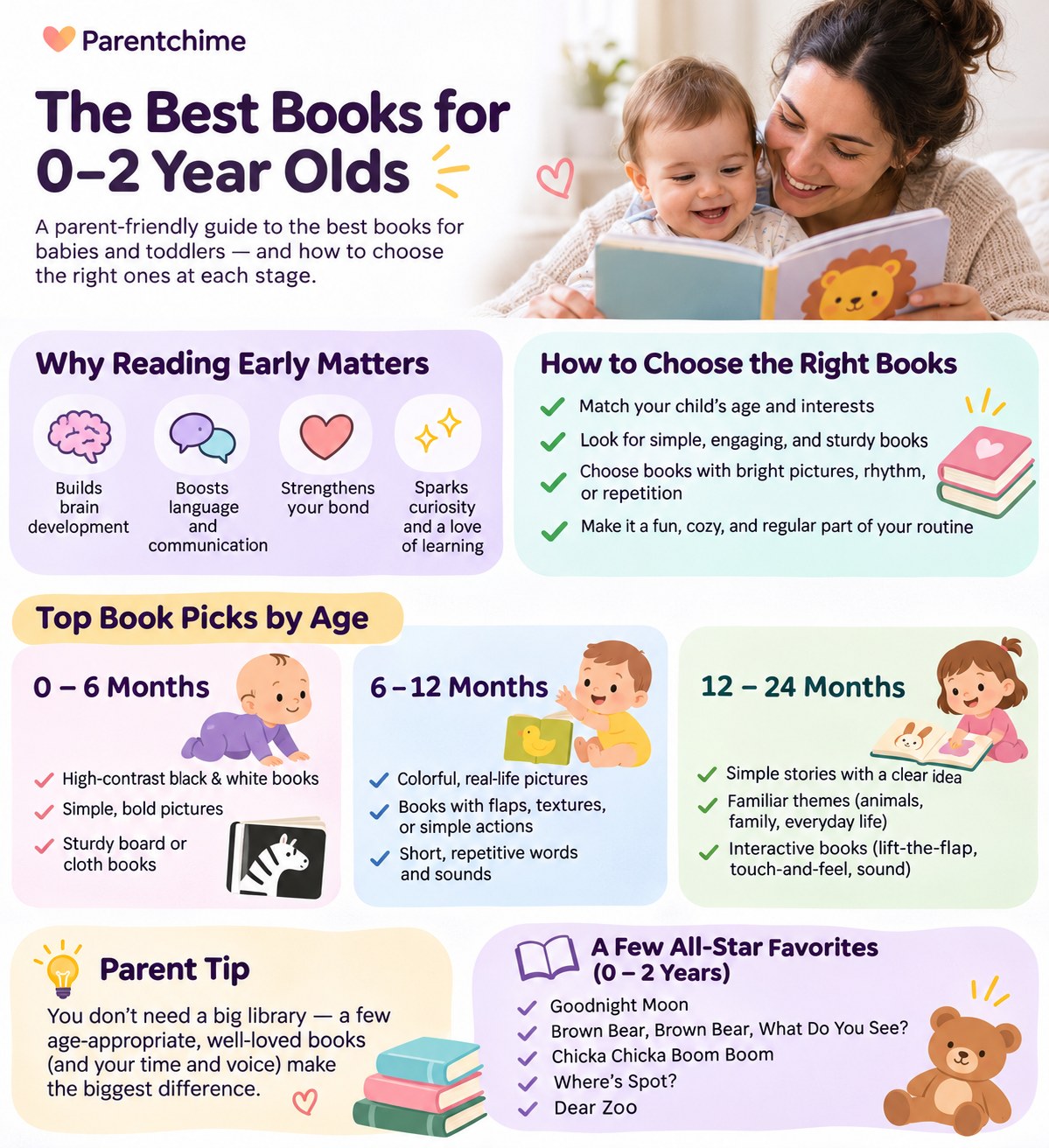
Why read to a baby who cannot talk yet?
Babies start learning about language long before their first words. The American Academy of Pediatrics (AAP) recommends reading with children from birth, continuing at least through kindergarten. Shared reading supports:
- Language: new words, rhythms and sounds.
- Bonding: connection through voice, touch and attention.
- Early literacy: linking pictures, words and books.
- Routine: comfort in something predictable and shared.
You don't need flashcards, an expensive library or a fixed schedule. A few enjoyable minutes with a book is plenty.
The 10 best board books for children under 2
1. Brown Bear, Brown Bear, What Do You See?
By Bill Martin Jr., illustrated by Eric Carle · USA · Best for: colours, animals and repetition
A brown bear sees a red bird, the red bird sees a yellow duck, and the colourful parade carries on. The repeating question and bold animals make the book predictable, so toddlers soon point, name the animals and join in.
Try this: Pause before revealing the next animal and ask, "What do you see?" A point or an excited sound counts.
Find Brown Bear, Brown Bear on Amazon India
2. The Very Hungry Caterpillar
By Eric Carle · USA · Best for: food, counting and exploring
A tiny caterpillar hatches, eats its way through a week of foods and turns into a butterfly. The bright pictures and little holes in the pages suit curious fingers. Younger toddlers enjoy naming the foods, and older ones can start counting and learning the days of the week.
Try this: Let your child poke a finger through the holes and name foods they know, like apples and strawberries.
Find The Very Hungry Caterpillar on Amazon India
3. Goodnight Moon
By Margaret Wise Brown, illustrated by Clement Hurd · USA · Best for: bedtime routines
A little bunny says goodnight to the things around the room. That is the whole story, and the simplicity is what makes it special. The gentle rhythm and familiar objects make it a comforting end to the day.
Try this: After reading, say goodnight to a few things in your child's room. Goodnight teddy. Goodnight window. Goodnight light.
Find Goodnight Moon on Amazon India
4. Dear Zoo
By Rod Campbell · UK · Best for: animal discovery and interactive play
A child asks the zoo to send a pet, but every animal is wrong. One is too big, another too tall. Children lift the flaps to find out who arrived next, and the repeating pattern builds anticipation.
Try this: Make each animal's sound as you open a flap, and ask your toddler to guess who is hiding.
5. Moo, Baa, La La La!
By Sandra Boynton · USA · Best for: animal sounds and playful rhythm
Cows moo. Sheep baa. And three pigs sing la la la. It is a short, rhythmic and very silly read-aloud, perfect for children who love making noise.
Try this: Pause before each sound and let your toddler fill it in, as dramatically as you like.
Find Moo, Baa, La La La! on Amazon India
6. Guess How Much I Love You
By Sam McBratney, illustrated by Anita Jeram · Northern Ireland, UK · Best for: bonding and bedtime
Little Nutbrown Hare and Big Nutbrown Hare try to show how much they love each other, with ever bigger comparisons. Babies enjoy the soothing language and your familiar voice, and toddlers can join in with movements.
Try this: Stretch your arms wide as you read, then ask your toddler to show you how big their love is.
Find Guess How Much I Love You on Amazon India
7. Where's Spot?
By Eric Hill · UK · Best for: hide-and-seek and curiosity
Spot the puppy is missing, and his mother goes looking. Is he behind the door? Inside the clock? Each flap reveals a new surprise, and the hide-and-seek pattern gives toddlers a reason to look at every page.
Try this: Afterwards, hide a soft toy behind a cushion and ask your toddler to find it.
Find Where's Spot? on Amazon India
8. Ten Little Fingers and Ten Little Toes
By Mem Fox, illustrated by Helen Oxenbury · Australia · Best for: rhymes and body awareness
Babies are born in different places and into different families, yet they all share ten little fingers and ten little toes. The rhythm and Helen Oxenbury's gentle pictures celebrate babies around the world, and it reads aloud beautifully even before a child understands the words.
Try this: Gently count your baby's fingers and toes as you read. With older toddlers, ask them to show you their hands and feet.
Find Ten Little Fingers and Ten Little Toes on Amazon India
9. Pat the Bunny
By Dorothy Kunhardt · USA · Best for: touch-and-feel play
Paul and Judy invite your child to pat a fuzzy bunny, smell the flowers, play peekaboo, look in a mirror and feel Daddy's scratchy face. First published in 1940, it turns reading into a game of touch and play, so even the youngest babies have something to do.
Try this: Guide your baby's hand across each page and name what they feel: soft, scratchy, smooth.
Find Pat the Bunny on Amazon India
10. Hug
By Jez Alborough · UK · Best for: cuddles and feelings
Little chimp Bobo wanders through the jungle watching other animals hug their parents, and he has just one word to say: "Hug." The story is told almost entirely through the pictures, which makes it easy to read to the youngest babies and a joy for toddlers to say out loud.
Try this: Finish the book with a real hug, and say "Hug!" together.
All ten links open Amazon India searches. Stock, format and prices vary by seller, and imported titles such as Pat the Bunny can be harder to find, so check the exact edition before you buy. Handle flaps and touch-and-feel pages gently and supervise young children.
Where to start: You don't need all ten at once. For a first little library, begin with Brown Bear, Brown Bear, Goodnight Moon and The Very Hungry Caterpillar. Together they give you colour, repetition, bedtime comfort and interactive fun. Add Dear Zoo or Pat the Bunny when your baby loves to touch and explore.
How to read with a 0–2-year-old
0–6 months: listen. Choose short rhymes and bold pictures. Your baby responds to your voice and face long before the story.
6–12 months: explore. Point to pictures and name them, and help your baby turn pages. Chewing and handling the book count as reading.
12–18 months: interact. Add animal sounds, repeated phrases and simple questions like "Where's the dog?" A gesture is an answer.
18–24 months: join in. Pause before familiar words and invite pointing, naming and guessing what happens next. If your toddler wants the same book for the fifteenth time, go ahead. Repetition is how they learn.
Five simple ways to build a reading habit
- Keep books within reach. A few sturdy books in a low basket.
- Read for a few minutes at a time. Stop when your child loses interest.
- Repeat favourites. Familiar books help children recognise words and predict what comes next.
- Use your home language. Read, translate or describe the pictures in Hindi, English, Kannada, Tamil or whatever your family speaks.
- Tie it to a routine. Bedtime, after a bath or a quiet afternoon cuddle.
The aim is to help your child link books with happy time together.
The best first book is the one you read together
Your child may chew the book, skip pages, point at the same animal again and again and demand their favourite story tomorrow. That is how a love of books begins, one page, one laugh and one cuddle at a time.
Little Readers, Big World is Parentchime's November reading series, bringing together beloved books from babies to teenagers. Next in the series: 10 Best Books for 2 to 3 Year Olds.
Make room for the little moments
Parenting comes with a lot to remember, from growth and nutrition to school activities and birthdays. Parentchime is your parenting assistant, helping you organise the details so you have more time for the moments that matter.
Explore Parentchime. Available on the Apple App Store.
The age recommendations and book notes are Parentchime editorial guidance. Every child develops at their own pace.
Comments
No comments yet. Be the first to share what worked for your family.